People may not understand how difficult turning an entire thesis into a short presentation can be. Imagine fitting years of research, pages of literature, detailed methods, and extensive results into a deck that your committee can follow easily.
That’s what it takes to build a thesis defense presentation. A defense is not about reading your thesis aloud. It is about showing that you understand your research, can explain its significance, and can justify the decisions behind it.
In this article, you’ll learn how to select the right content, structure your slides, present research visually, and prepare for questions for a thesis presentation.
Key Takeaways:
- Keep only the research details needed to understand your question, method, findings, and contribution.
- Build a logical flow from the research problem to your conclusions.
- Use visuals to make important evidence easier to understand.
- Prepare backup slides and practice answers for likely committee questions.
What Is a Thesis Defense Presentation & Its Key Elements
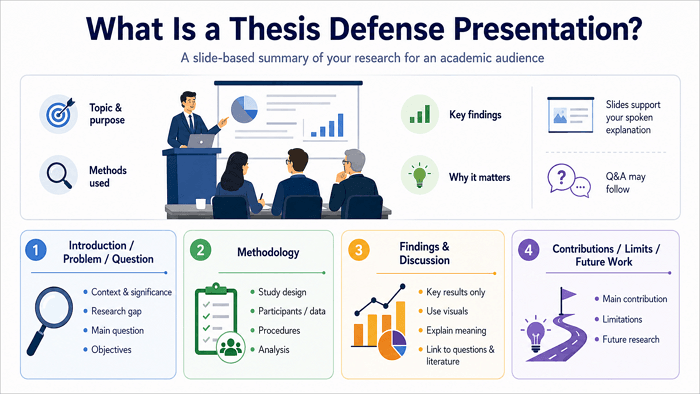
A thesis defense presentation is a slide-based summary of your research that you deliver to an academic audience. It explains what you investigated, how you investigated it, what you discovered, and why those findings matter.
Unlike the written thesis, the presentation cannot include every detail. Your slides should support your spoken explanation while giving the committee a clear view of your research argument. A Q&A session may follow, where committee members probe your methodology, findings, limitations, or conclusions.
Here are the most important elements of a thesis presentation:
1. Introduction, Problem, and Research Question
Open with enough context to explain what makes your topic significant. State the problem, research gap, main research question, and objectives. Your literature review should only include concepts needed to establish the gap and frame your research.
2. Methodology
Explain how the study was conducted and what made your approach appropriate. This may include the design, participants, data sources, procedures, instruments, and analysis methods. There’s no need to include technical details that you can explain verbally if asked.
3. Findings and Discussion
When preparing your findings, prioritize the ones that directly answer your research questions rather than showing every result collected during the study. You can make patterns easier to see using charts, tables, diagrams, and other visuals.
After presenting a result, explain what it means. Connect important findings to your research questions and relevant literature.
4. Contributions, Limitations, and Future Work
Clearly explain what your research contributes to the field. Then acknowledge genuine limitations without unnecessarily weakening your work. End this section by identifying reasonable areas for future research based on what your study discovered.
How to Create an Effective Thesis Defense Presentation
Now, let’s go into how you can turn your detailed thesis into a focused argument that works within your presentation time. You can design the slides using any presentation tool of your choice, such as PowerPoint or Google Slides.
Step 1. Decide What to Keep and What to Cut
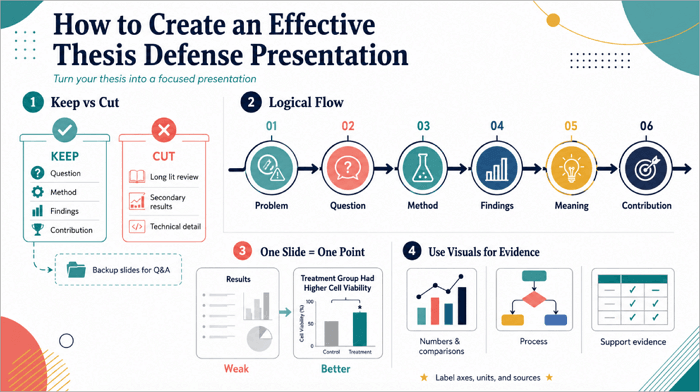
Identify the information necessary for the committee to understand your research question, approach, findings, and contribution. These are the details that should make it into your PowerPoint for defense.
Cut lengthy literature discussions, secondary results, and technical details that do not support your main argument. If the information may become useful during Q&A, you can move it into backup slides.
Step 2. Build a Logical Flow
Give the presentation a clear narrative:
Problem → Research Question → Method → Findings → Meaning → Contribution
Each section should naturally lead into the next. For example, introduce the research gap before presenting your question, then explain how your methodology addresses that question.
Step 3. Make Each Slide Communicate One Point
Give every slide a clear purpose. Instead of using generic titles such as “Results” or “Methodology,” write titles that tell the audience what matters. For example, “Treatment Group Showed Higher Cell Viability” provides more information quickly than “Results.”
Step 4. Use Visuals for Evidence
Charts, diagrams, and tables usually communicate research data faster than paragraphs of text. Use them for numbers, comparisons, or processes, and label every visual with axes, units, and sources.
For example, if your methodology involves a multi-step process, a simple flowchart is easier to follow than a bulleted list.
Thesis Defense Presentation Tips
An effective thesis defense PowerPoint presentation should look professional, remain easy to read, and support your research argument. Follow these principles when creating yours:
✅ Maintain a consistent layout: Choose readable fonts, strong contrast, simple backgrounds, and consistent spacing. Keep headings, body text, colors, and slide elements uniform throughout the presentation.
✅ Keep text concise: Replace paragraphs with short phrases, bullet points, and clear headings. Explain supporting details verbally rather than overcrowding slides.
✅ Use purposeful visuals: Use charts for comparisons, diagrams for processes, tables for exact values, and images when they clarify research context. Ensure every visual supports your message.
✅ Improve readability: Make visuals large enough to read. Label axes, units, categories, legends, and sources. Use color to emphasize key findings, and avoid excessive animation or complicated transitions.
✅ Start with a Professional Template: If you’d rather not build a layout from scratch, AiPPT.com offers ready-made thesis defense presentation templates as a structured starting point.
How to Prepare a Thesis Defense Presentation Using AiPPT.com
You’ve spent months on this research. You shouldn’t have to spend another week struggling with slide formatting. This is where AiPPT.com comes in handy.
This AI presentation tool helps you:
- Organize your thesis draft into structured slides.
- Generate a suitable outline so you don’t start from a blank deck.
- Provide template options to keep your slides polished.
- Add charts and diagrams to make your findings easier to follow.
Here’s how you can quickly generate a thesis defense PPT on AiPPT.com:
Step 1: Go to AiPPT.com to sign up, or sign in if you already have an account.

Step 2: Switch to Flow and upload your thesis content, such as your document, abstract, or key sections.

Step 3: Choose an academic template that fits your subject and proceed to generate the PPT.
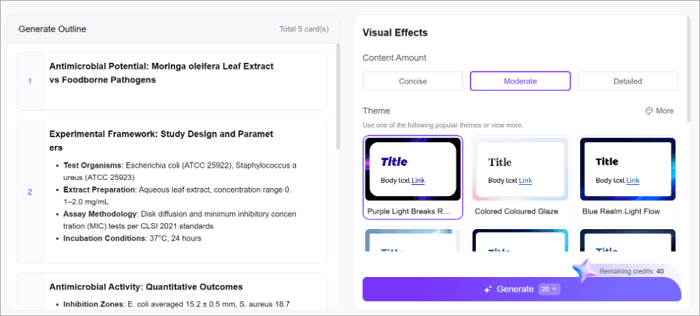
Step 4: Use the Insert menu on the right to add or refine charts, diagrams, and other visuals.
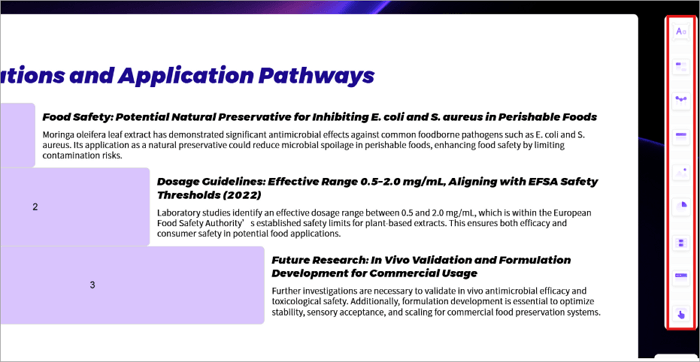
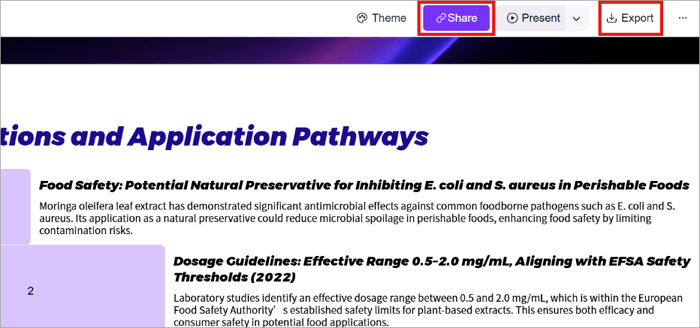
Step 5: Review and edit the slides for flow and accuracy. Then, click on the “Export” or “Share” button to save the finished presentation.
Conclusion
A thesis defense presentation does more than just summarize a thesis. It shows you understand your research deeply enough to explain it, justify your decisions, and defend your conclusions under questioning.
Before creating your thesis presentation in PowerPoint or AiPPT.com, identify your research question, your strongest finding, and your main contribution. Use them as the foundation for the deck, then build the supporting evidence around them.
FAQs on Thesis Defense Presentation
Preparing the slides is only part of the process. These answers cover some common questions students have when building and presenting their defense deck.
1. What is a research defense?
A research defense is an oral presentation, usually followed by a Q&A, where a graduate student presents their thesis to a committee. The committee evaluates whether the student understands their research well enough to justify their methods, findings, and conclusions, and the outcome typically decides whether the degree is awarded.
2. How to make a PPT for a research defense?
Here’s how to make a PowerPoint for a research defense:
- Check your department’s presentation requirements and time limit.
- Create an outline covering the problem, question, method, findings, and contribution.
- Build slides around the most important evidence.
- Add clear charts, diagrams, or tables where useful.
- Review the deck and add backup slides for likely questions.
3. How do you start a thesis defense presentation?
After creating your thesis presentation, the next step is delivering it before the panel. Here’s how to start the presentation:
- Introduce yourself and your research topic.
- Then, talk about the central problem your study addresses.
- Briefly explain why the problem matters and identify the research gap.
- State your research question or objectives before transitioning into your methodology.