Some conversations flow smoothly without any effort, while others go wrong right from the first sentence.
Every conversation, presentation, meeting, and social media post follows patterns, and a communication model is simply a way of describing those patterns. Once you can see the pattern, you can fix what breaks it.
This post walks you through the three major categories, the eight most influential models ever developed, and where each one appears in everyday life.
But first, let’s compare these communication models across various metrics before going into details.
| Model | Category | Key Feature | Example |
| Aristotle | Linear | Persuasion | Public speaking |
| Lasswell | Linear | Five questions | Media |
| Shannon-Weaver | Linear | Noise | Phone calls |
| Berlo’s SMCR | Linear | Four components | Training sessions |
| Schramm | Interactive | Feedback | Email exchanges |
| Osgood-Schramm | Interactive | Circular roles | Text conversations |
| Barnlund | Transactional | Simultaneous messages | Face-to-face talks |
| Dance’s Helical | Transactional | Evolves over time | Long-term relationships |
What are Communication Models?
In basic terms, communication models are frameworks that help us understand how information moves from one person to another.
Think of it as a conversation diagram showing who is speaking, what they are saying, how the message travels, and what happens when it arrives.
Each model of communication highlights different aspects of the communication process, including the sender, feedback, context, or outside distractions. None of them tells the whole story, but together they provide a clearer understanding of how communication works in different situations.
The Three Types of Communication Models
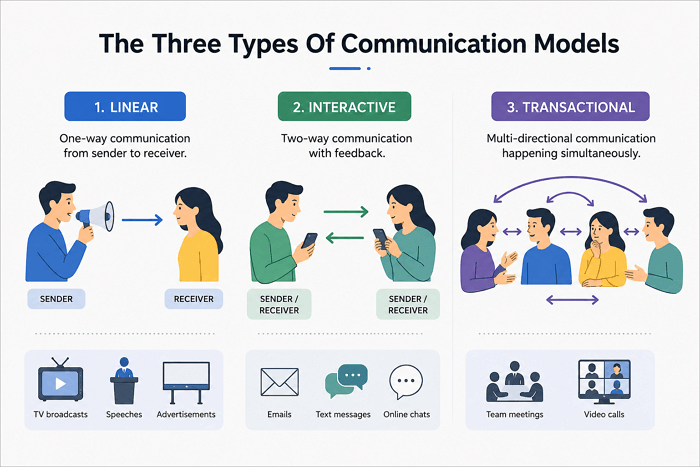
All the models of communication we’ll explore here are broadly categorized into three groups, including:
1. Linear Communication Models
The linear model of communication is the simplest form here. This is because information only moves in one direction, from the sender to the receiver, with no feedback loop.
TV broadcasts, political speeches, and billboard advertisements all work this way. The audience receives the message but doesn’t have a built-in channel to respond.
2. Interactive Communication Models
Interactive models made communication theory more realistic by introducing feedback. Here, people can also reply to messages rather than just receive them.
Common examples of these models are emails, text messages, and online chats. One person sends, the other responds, then the roles swap again.
3. Transactional Communication Models
The transactional model of communication reflects how people communicate daily. Everyone sends and receives at the same time, through words, facial expressions, tone, and body language.
A good example is a team meeting or a Zoom call. While you’re talking, your colleagues are already nodding or frowning, and those signals influence what you say next.
The 8 Models of Communication
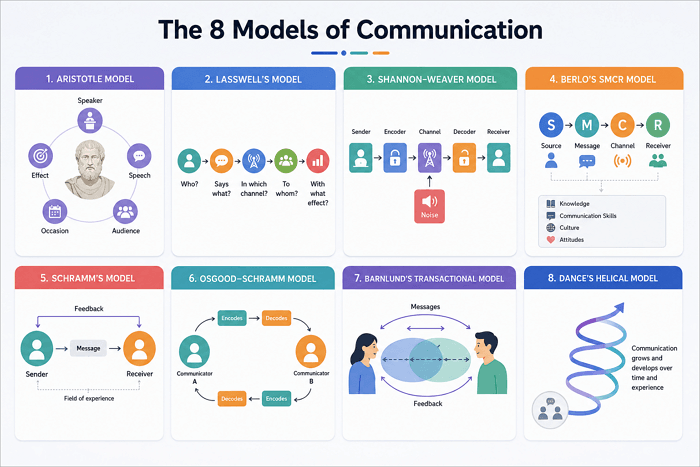
These eight communication models appear in almost every communication textbook, and each adds something new to our understanding of human interaction.
1. Aristotle Model
The Aristotle model of communication is the oldest on this list, dating back to ancient Greece. It focuses on five elements of communication: the speaker, speech, audience, occasion, and effect.
Aristotle believed that successful communication depends on the speaker’s ability to persuade an audience, making his model relevant in public speaking, political campaigns, debates, and presentations today.
2. Lasswell’s Model
Harold Lasswell introduced a simple framework that answers five questions:
- Who?
- Says what?
- In which channel?
- To whom?
- With what effect?
These questions make it easy to analyze how messages are delivered and received. This explains why Lasswell’s model is still widely used in journalism, advertising, public relations, and media studies.
3. Shannon-Weaver Model
This model was created to explain electronic communication, but it soon became useful for understanding human interaction as well.
Its most memorable concept is noise—anything that distorts a message along the way. This can include poor Wi-Fi connections, loud background sounds, and unclear wording.
4. Berlo’s SMCR Model
David Berlo’s communication model has four components:
- Source: The person sending the message.
- Message: The information being shared.
- Channel: The medium used, such as speech, email, or video.
- Receiver: The individual or group receiving the message.
The model also recognizes that communication is influenced by knowledge, communication skills, culture, and attitudes.
5. Schramm’s Model
Wilbur Schramm put feedback at the center of communication theory. In his view, a message is not complete until the receiver responds and the sender adjusts.
Earlier models treated communication like a machine pushing data down a pipe. Schramm reframed it as a human process that negotiates meaning.
6. Osgood-Schramm Model
Working with Charles Osgood, Schramm later developed a fully circular model. There is no fixed sender or receiver. Instead, both parties continuously encode, decode, and interpret messages, switching roles the entire time, like in a WhatsApp group chat with a close friend.
7. Barnlund’s Transactional Model
Dean Barnlund pushed the idea that people send and receive simultaneously, rather than taking turns. You’ll come across this model in face-to-face discussions. While one person speaks, the other communicates constantly through eye contact, posture, and expressions. The speaker adapts in real time.
8. Dance’s Helical Model
Frank Dance compared communication to a growing spiral, or helix, that widens as it rises. It basically means that every conversation with a person is shaped by all previous conversations with them. This is why talking to a stranger feels different from talking to an old friend.
Real-Life Examples of Communication Models
It’s easier to recognize these theories when you can see them in action. Here are some everyday examples where several models of communication work together at once.
1. Classroom Discussions
Take a university lecture hall. Assume the professor talks while the class listens for the first 20 minutes. That represents a linear information communication model where the message travels one way, from source to audience—with no built-in channel for response.
The moment a student raises their hand, that structure breaks. The professor answers, the student follows up, and the exchange becomes interactive, matching Schramm’s model of continuous feedback.
2. Team Meetings
Picture a manager opening a monthly or quarterly results meeting. For the first few minutes, they present numbers and try to persuade the room that the plan is working, leaning on credibility and logic in a style Aristotle would recognize, with dense metrics adding a layer of Shannon-Weaver-style noise.
However, a team member can enter the structure to ask questions or disagree with a projection. This might make the manager revise their point, and the room shifts into open, simultaneous back-and-forth, also identical to Schramm’s feedback loop.
3. Marketing and Public Speaking
Let’s consider a billboard ad. Here, a brand crafts one message and places it for thousands of drivers to see, with no direct channel to hear back from them. This is a close-to-pure linear model of communication.
A keynote speaker at a product launch may, however, take a different approach. They read the audience’s energy and adjust pacing in real time, layering Aristotle’s persuasive appeals onto something closer to interactive exchange.
Create Communication Model Presentations with AI
Communication models are common topics in classrooms, corporate training sessions, workshops, and professional development programs. With AI tools such as AiPPT.com, you can build slides automatically with comparison tables, diagrams, timelines, and visual examples.
Key features of AiPPT.com include:
✅ AI-powered slide generation from text or document
✅ Customizable templates and themes
✅ Multi-format export such as PPT and PDF
✅ Real-time collaboration on presentations
Here’s how to create a presentation with AiPPT.com:
Step 1: Sign up on AiPPT.com using a preferred option.
Step 2: Type a prompt like “the 8 models of communication with examples” or upload a document.
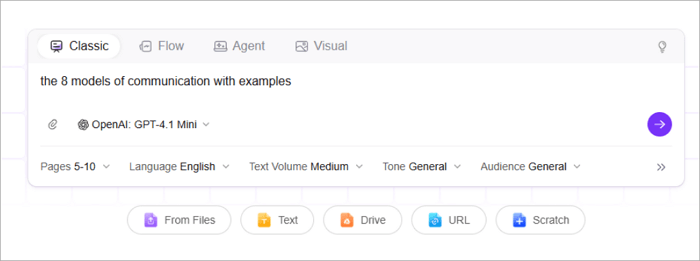
Step 3: Review the generated outline and choose a template to continue.
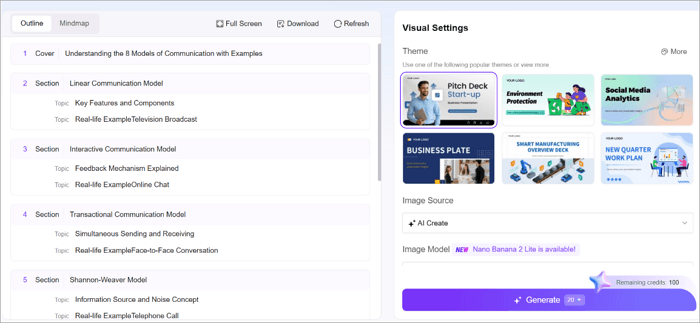
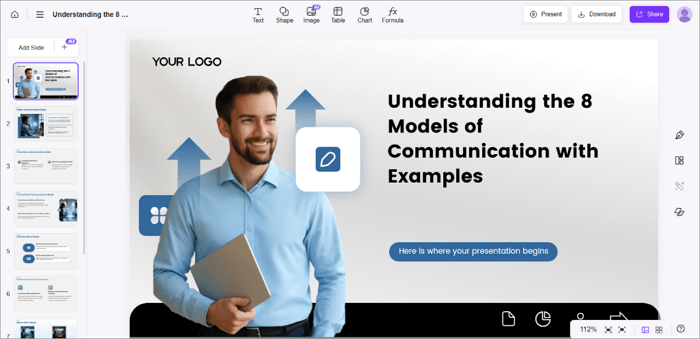
Step 4: Customize the content to help your audience understand each communication model more effectively.
Conclusion
All of these communication models continue to matter in this age of social media, video calls, instant messaging, and AI, particularly because the ideas behind them are still relevant.
The most effective communicators rarely stick to a single communication model. They naturally adjust their style depending on the audience, purpose, and situation. When you understand those patterns, you become a more confident communicator yourself.
So the next time you’re creating a presentation, try exploring one communication model in greater depth and turn it into a visual explanation using presentation tools like AiPPT.com.
FAQs on the Model of Communication
Now that you’ve seen how different communication theories work, here are answers to some of the most common questions people ask about models of communication.
1. What are the models of communication?
Communication models are frameworks that explain how messages move between senders and receivers.
They simplify the communication process by highlighting elements such as the sender, receiver, message, channel, feedback, and context. Different models focus on different aspects of communication, making each one useful for specific situations.
2. What are the 5 models of communication?
There are many communication models, but five of the best-known include:
- Aristotle Model
- Lasswell Model
- Shannon-Weaver Model
- Berlo’s SMCR Model
- Schramm’s Model
Together, they show how communication evolved from simple one-way message delivery to more interactive processes that include feedback and shared understanding.
3. Which communication model is most commonly used today?
The transactional model, particularly Barnlund’s version, is considered the most applicable to modern communication. Face-to-face conversations, video calls, and instant messaging all involve people sending and receiving messages at the same time, adjusting continuously to feedback, context, and nonverbal cues, which is exactly what transactional models describe.