Public speaking comes in handy in scenarios such as school presentations, meetings, or group discussions where you need to share ideas.
However, a common mistake people make is not realizing that there are different types of public speaking, and using the wrong one often leads to weak communication. For example, delivering a persuasive talk like an informative one would fail to influence the audience.
In this guide, you’ll learn what public speaking is, its key elements, and the main styles used in real situations.
What is Public Speaking?
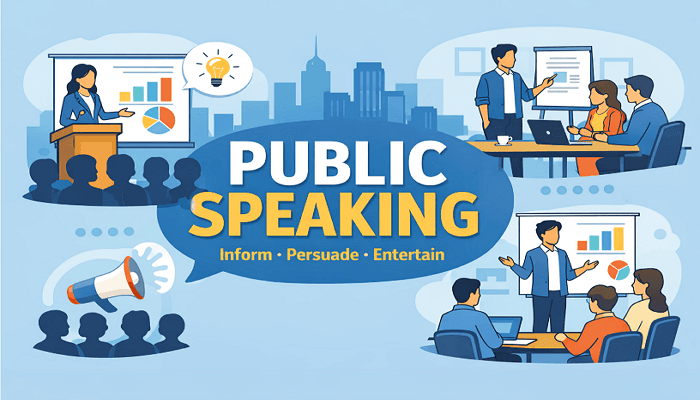
At its core, public speaking is the process of communicating ideas to an audience with a clear purpose — to inform, persuade, or entertain.
This communication is not limited to conference stages or TED talks. It happens in many everyday situations like presenting a project in class, explaining a report at work, or introducing an idea during a meeting. Even though the audience may be smaller and more specific, these situations still involve addressing the public.
In essence, public speaking comes down to one or more people intentionally communicating with a group.
Key Elements of Public Speaking
To really understand how it works, you need to know the various elements of public speaking. Regardless of its format, every effective speech is built on the same core parts, which we’ll explore here.
| Element | Description |
|---|---|
| 1. Speaker | The person delivering the message. Credibility and confidence influence how the audience responds. |
| 2. Audience | The listeners. Consider their needs, expectations, and knowledge level when communicating. |
| 3. Message | The main idea you want to share. It must be clear, structured, and easy to understand. |
| 4. Delivery | How you present the message. It includes voice, gestures, pacing, and tone. |
| 5. Feedback | The audience’s reaction, which may include questions, expressions, etc. |
| 6. Context | The setting and purpose. It includes the environment and the speaking goal. |
7 Types of Public Speaking
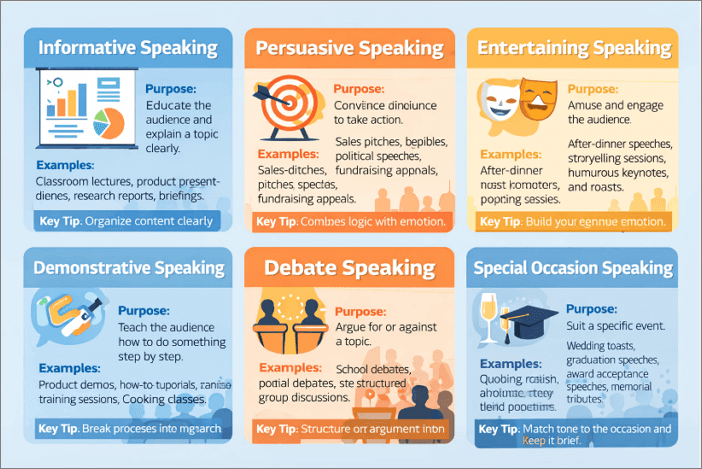
Although most speeches share the same core elements, choosing the right speaking style depends on your goal, audience, and scenario. Here are the most common types of public speaking you should know.
1. Informative Speaking
Purpose: Educate the audience and explain a topic clearly.
Examples: Classroom lectures, product presentations, research reports, briefings.
Informative speaking is a popular type of speaking used in professional and academic settings. Its goal is to share knowledge that the audience doesn’t already have in a clear, structured way.
You can use it when presenting quarterly results in a business meeting or explaining a new process to your team.
Key tip: Organize content in a clear and logical sequence. Also, remember to focus on relevant details.
2. Persuasive Speaking
Purpose: Convince the audience to take action.
Examples: Sales pitches, debates, political speeches, fundraising appeals.
This is a different type of speaking entirely. Persuasive speaking aims not only to convince the audience to take action, but also to accept an idea or opinion.
For example, when presenting a project proposal using slides, your goal is to persuade stakeholders to approve it. That makes persuasive speaking the best choice.
Key tip: Combine logic with emotion by giving the audience evidence to think with and a reason to care.
3. Demonstrative Speaking
Purpose: Teach the audience how to do something, step by step.
Examples: Product demos, how-to tutorials, training sessions, cooking classes.
Many types of public speaking focus on telling, but demonstrative speaking takes it a step further by showing. Basically, it combines explanation with step-by-step guidance, and benefits most from visual aids.
If you’ve ever watched a tutorial video on how to perform a task, you’ve seen demonstrative speaking in action, and you can also deliver yours in a similar format.
Key tip: Break the process into numbered steps so the audience can stay on track with you.
4. Entertaining Speaking
Purpose: Amuse and engage the audience.
Examples: After-dinner speeches, storytelling sessions, humorous keynotes, and roasts.
The goal of entertaining speaking is not just to make people laugh, but to create a memorable experience in the process of informing them.
Among the different types of speech, this one requires the most emotional intelligence. You must be able to read the room, adapt your tone, and connect with the audience on a more personal level.
Storytelling comes in handy here, and a well-told story can retain audience attention far better than a list of facts.
Key tip: Build your content around a genuine emotional connection.
5. Motivational Speaking
Purpose: Inspire the audience to take action or believe in what’s possible.
Examples: Keynote speeches, sports coaching talks, and personal development sessions.
Motivational speaking is another speaking skill that bridges storytelling and persuasion. A great motivational speaker doesn’t just make the audience feel good; they encourage people to take action.
These speeches often include personal stories, authenticity, and energetic delivery. However, the message should feel genuine and relevant, not like a rehearsed script.
Key tip: Anchor your message in a relatable story.
6. Debate Speaking
Purpose: Argue for or against a topic.
Examples: School debates, political debates, structured group discussions.
Debates have to do with presenting structured arguments and backing them with evidence. You’ve most likely participated in a debate at some point in your education or career.
They might look simple, but debates demand quick thinking, strong reasoning, and the ability to stay composed — even under pressure. You should know your topic deeply enough to anticipate objections before they are raised.
Key tip: Structure your argument clearly into claim, evidence, and explanation.
7. Special Occasion Speaking
Purpose: Suit a specific event.
Examples: Wedding toasts, graduation speeches, award acceptance speeches, memorial tributes.
For this kind of speaking, there’s no single formula because each event has its own emotional weight and audience expectations.
For example, a wedding toast needs warmth and humor, a memorial tribute needs sensitivity and sincerity, an award speech needs gratitude, and so on.
Key tip: Match tone to the occasion and keep it brief.
How to Choose the Right Type of Public Speaking
It can be a bit overwhelming to choose one from the types of public speaking we’ve covered. However, you only need to consider three things when deciding.
1. Your goal
What do you expect from the audience after speaking? Start by identifying what you want to achieve with your speech. For example, persuasive speaking comes in handy when you need them to act or change their minds.
2. The audience
Next, think about who you are speaking to. Their knowledge level and expectations should influence your approach. For a general audience, you may want to keep your speech simple and use storytelling, while providing detailed explanations for a more technical audience.
3. The situation
What does it call for? The setting and occasion often determine the appropriate style for you. A business meeting would require a different approach from a celebration. The context usually answers away.
Types of Speaking Skills and How to Improve Them
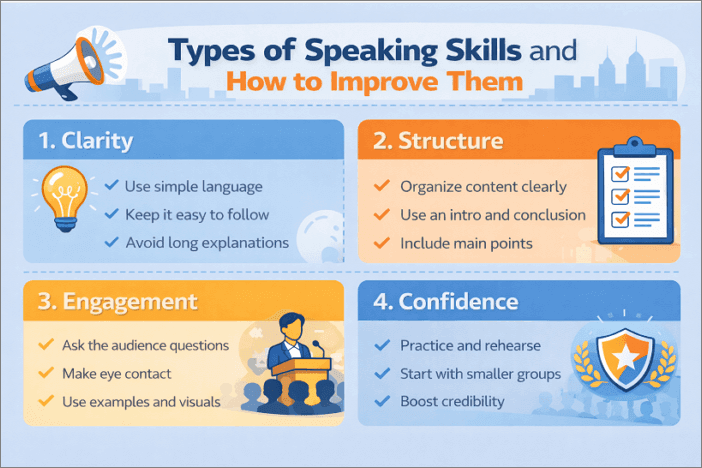
A lot of people struggle with speaking in public, and that’s usually because they haven’t improved the necessary speaking skills. Below are some skills you may need to focus on.
1. Clarity: Communicate clearly to help the audience understand your message quickly. When your ideas are easy to follow, people are more likely to stay engaged and remember what you said. Use simple language and avoid long explanations. Speaking vaguely is the fastest way to lose an audience.
2. Structure: A good structure gives you flow and also helps you stay organized and confident while speaking. To improve the flow of your speech, organize it into an introduction, main points, and conclusion.
3. Engagement: One of the ways to keep the audience’s attention is by engaging them in your speech as much as you can. Do this by asking questions, using examples, making eye contact, varying your pace, and including visuals.
4. Confidence: This shows how credible you are and makes your message more convincing. For many speakers, confidence is often the biggest barrier, but it can easily be improved. You can become more confident by rehearsing your speech out loud beforehand.
Conclusion
Understanding the various types of public speaking will help you communicate more effectively during speeches, presentations, meetings, and even in everyday conversations.
In addition, being aware of these categories will help you avoid common mistakes like using a persuasive tone when the audience only needs information. This way, you communicate with more purpose and impact.
A simple way to practice this is to observe your daily conversations or class presentations and identify the speaking type you naturally use. Over time, you can try switching styles based on your goal.
Learn More About Public Speaking
Before you step onto that stage, there are three things every speaker should understand — from defining public speaking to knowing the different speech types and styles.
What are the five main types of speeches?
The five main types of speeches include:
- Informative to educate
- Persuasive to influence opinions
- Demonstrative to teach steps
- Entertaining to engage
- Motivational to inspire action
Public Speaking Definition: What Does It Mean?
Public speaking refers to delivering a structured message to an audience to inform, persuade, or entertain. It can happen in classrooms, meetings, or even presentations.
The process of public speaking involves several key steps that work together to ensure effective communication:
- Preparation: Researching your topic, organizing ideas, and understanding the audience.
- Clear delivery: Presenting your message in a structured and easy-to-follow way, using simple language, tone, and pacing.
- Audience: Connecting with listeners through eye contact, questions, and examples.
What are the types of speaking in communication?
There are several kinds of speaking used in communication, including:
- Informative speaking
- Persuasive speaking
- Demonstrative speaking
- Entertaining speaking
- Motivational speaking
- Debate speaking
- Special occasion speaking
These different types of speech are used depending on purpose, audience, and context. Choosing the right type improves clarity, engagement, and communication effectiveness.