How you begin your debate speech can literally decide if you’re worth listening to or not. Whether it’s a school debate, class presentation, or competition, the first few words you say set the tone of your argument, build credibility, and help the audience understand you. This is to say: a good beginning can determine whether you have a great finish.
It is therefore important that you know how to start a debate rightly—carrying the audience along from the beginning. In this guide, we will show you how to begin your speech strongly, the core elements to include, step-by-step guidance, and practical examples.
What is a Debate and Why Start Strong?
A debate is a form of discussion in which two people express opposing opinions on a topic. One side agrees on the topic, while the other side disagrees. In a debate, both parties provide reasons to support their arguments, and there’s a panel to make a judgment based on the side with the most convincing argument.
To have the “most convincing argument,” it is important to start strong. This will allow the audience to grasp the arguments clearly and follow along as you are speaking. If you fail to start strong, the audience will become confused or bored.
This tip applies to all forms of speech, whether professional, public speaking, or current topics discussed in a group.

How to Start a Debate Speech: Core Elements
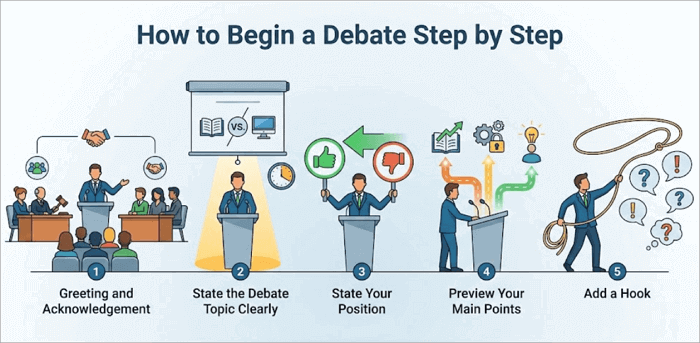
The most effective debate speech usually starts with 5 essential elements. These are:
- Greeting: It sets a polite tone and shows gratitude for the presence of all the listeners.
- Statement of Motion: This is to inform the listeners that the topic is being debated.
- Position: You have to clearly state which side you stand on. Let them know if you agree or disagree with the topic.
- Preview of Points: Here, you list the reasons for your position without going into too much detail.
- Hook: You have to say something interesting enough for them to want to hear more.
This is how to begin a debate on any topic, whether a simple or controversial debate topic.
| Element | Purpose | Tip |
| Greeting | Sets a respectful tone | Be polite to judges, opponents, and the audience |
| Statement of Motion | Tells everyone the topic | Say it correctly and clearly |
| Position | Gives your stance on the topic | Use straightforward words like “I support” or “I oppose.” |
| Preview of Points | Provides a roadmap for the listeners to follow | Briefly list your main reasons |
| Hook | Grabs everyone’s attention | Initiate a question, fact, or short image idea |
How to Begin a Debate Step by Step
Having learned the basic elements for starting a debate speech, we can now discuss the step-by-step procedure.
Step 1: Greeting and Acknowledgement
Start by giving a warm welcome to the judges, opponents, and audience. Debate greetings show that you’re prepared and you respect everyone present.
Example: “Good morning, honorable judges, teachers, fellow students, and my co-debaters.”
Step 2: State the Debate Topic Clearly
This is where your argument would be established, and it is therefore prudent that you speak at a lower rate than usual to ensure that everyone understands what you are saying.
Example: “The motion for today’s debate is: Should homework be banned?”
Step 3: State Your Position
Make it known to them whether you are in favor of the motion or not. Clearly state which side you are on.
Example: “I strongly oppose the motion.”
Step 4: Preview Your Main Points
Now, briefly list your main reasons and keep them short. This is to make the listeners have a clue of what you are going to talk about.
Example: “I will prove this by showing you that homework improves practice, builds responsibility, and supports independent learning.”
Step 5: Add a Hook
End your introduction with something engaging—pose a rhetorical question, make a daring statement, or create suspense. This makes everyone pay keen attention to you as you speak along.
Example: “Do you want students to be able to stand on their own as they grow?”
Debate Writing Examples and Sample Openings
Below are practical debate writing examples with a great introduction that you can use as a guide when writing yours:
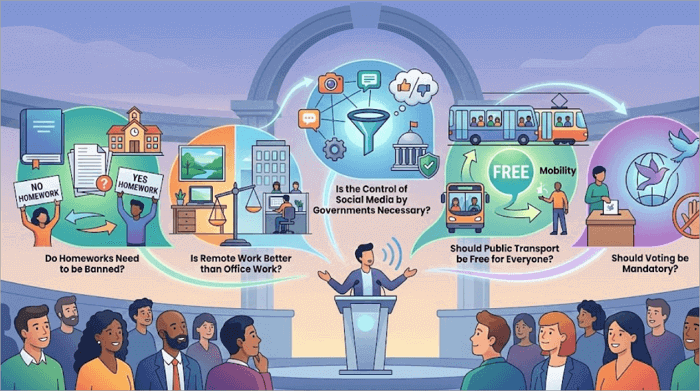
Topic 1: Do Homeworks Need to be Banned?
“Good morning, esteemed judges, teachers, fellow students, and my co-debaters. The debate for today is whether to ban homework. I firmly disagree with the motion, and I’m going to prove this by showing you that homework improves practice, builds responsibility, and supports independent learning. Before I continue, ask yourself this: Should students be able to stand on their own as they grow?”
Topic 2: Is Remote Work Better than Office Work?
“Good morning, distinguished panelists, worthy opponents, and everyone present. Today, we are debating whether remote work is better than office work. I strongly support this motion, and my reasons are that remote work offers increased productivity, lower costs, and better work-life balance. Primarily, work is about results, not location.”
Topic 3: Is the Control of Social Media by Governments Necessary?
“Afternoon, esteemed supporters, learned opponents, guests, and attentive listeners. The question being debated here is whether governments should regulate social media. I am a strong supporter of this motion, and I will show you that the regulation will protect users, curb negative content, and promote accountability. Social freedom brings out the best in people.”
Topic 4: Should Public Transport be Free for Everyone?
“Good day, panel of judges, fellow debaters, and audience members. We are here to debate whether public transportation should be free for all citizens. I strongly support this motion, and this is because it offers reduced traffic, equal access to mobility, and many environmental benefits. A city moves better when everyone can move.”
Topic 5: Should Voting be Mandatory?
“Good afternoon, able judges, co-debaters, guests, and members of the public. The motion before us today is whether voting should be mandatory. I firmly stand against it, and I will prove this with facts about personal freedom, informed choices, and democratic rights. First off, you must know that: a true choice comes from willingness, not forcefulness.”
Tips to Improve Your Debate Opening
Want to know how to write a debate speech better than anyone? Follow these pro tips:
✅ Greet Properly: Start a debate greeting by mentioning everyone present, such as the judges, opponents, guests, and audience.
✅ Speak Clearly: Pronounce every word fully and clearly so they can understand you. Don’t speak too quickly, and take pauses where necessary. It shows confidence.
✅ Stand Straight: People can tell if you’re confident from your posture. Stand straight, with your feet slightly apart. And when you feel the need to be mobile or more expressive, don’t move far away from the center podium.
✅ Make Eye Contact: Don’t be fixated on your notes throughout. You need to constantly make eye contact with the audience—it builds a connection.
✅ Use a Question or Fact: While speaking, initiate rhetorical questions or facts to keep the audience engaged.
✅ Practice frequently: You can stand in front of a mirror or set a video camera to check your body language.
Conclusion
A strong debate opening gives you control from the first second. It will make you sound confident, keep the listener’s attention, and make the argument easier to follow. A helpful fact to keep in mind is that you must have “structure”. When you know what you want to say and the order to follow, you won’t panic.
Now that you know how to start a debate, write a short opening today and practice it. The more you try, the more confident you become.
Learn More about Starting a Debate
Here are quick answers to some commonly asked questions about how to start a debate. Read on to learn more.
1. How to start a debate greeting in school?
Start politely and confidently. For example:
“Good morning, judges, teachers, and fellow students. The topic is: Should homework be banned? I strongly agree because it reduces stress and gives room for more extracurricular learning. Homework does not significantly improve academic performance.”
For more expertise, start with how to introduce yourself in a presentation as a student.
2. How to write a debate for students?
Follow these steps accordingly:
- Start by greeting everyone
- State the motion and your position
- Preview your points
- Initiate a hook
- Explain your points
- End with a strong conclusion
You can practice with some top fun debate topics to build your debate speech writing.
3. How to start a debate speech effectively?
Start with the 5 key elements: a polite greeting, the topic, your stance, points preview, and a hook. Keep your words simple and clear. Even when speaking on serious issues, don’t try to impress with big words.