Think about that time you chatted with a friend and how the conversation kept changing every single time. You reacted and adjusted your words based on their expressions, while they also did the same to you.
That back-and-forth is the foundation of the transactional model of communication, where messages, feedback, emotions, and context all influence the outcome of an interaction.
In this article, we’ll discuss how this communication model can be used in many situations, such as presentations and business meetings.
Key Takeaways:
- The transactional model of communication views communication as a continuous, two-way process.
- Everyone acts as both a speaker and a listener during an interaction.
- Feedback, context, and communication barriers influence every conversation.
- This model applies to everyday discussions, classrooms, workplaces, presentations, and online meetings.
What is the Transactional Communication Model?
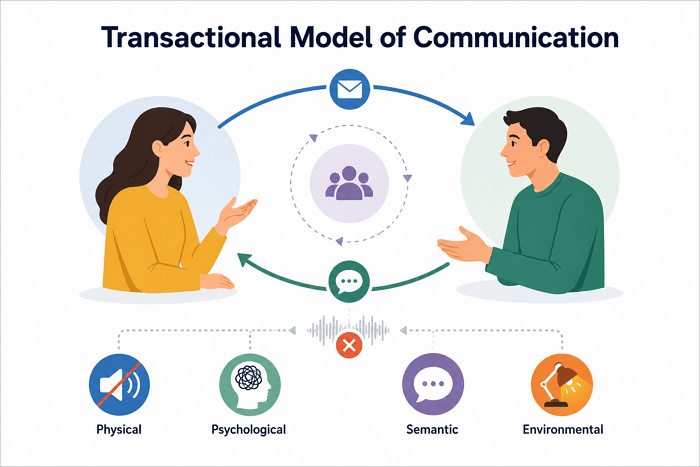
The transactional communication model describes communication as an ongoing process where everyone involved simultaneously sends and receives messages. It recognizes that every response influences what happens next.
For example, imagine you’re giving a presentation. While you’re speaking, you notice people nodding, looking confused, or checking their phones.
Those reactions become feedback that prompts you to slow down, explain a point differently, or move on. At the same time, your confidence, tone, and body language influence how the audience responds.
This is quite different from one-way communication, where the speaker delivers information, and the listener simply absorbs it, like a radio announcement or memo.
How the Transactional Model of Communication Works
Several elements work together to make communication work, and understanding how each piece interacts can help you communicate more effectively.
1. Communicators Act as Both Sender and Receiver
It is impossible to remain in one role in this transactional model. You become both the sender and the receiver throughout the conversation.
For example, while discussing a project with a teammate, you’re watching their expressions and listening to short responses such as “I see” or “That makes sense.” They are also interpreting your words while preparing their own response.
2. Messages and Continuous Feedback
Communication doesn’t pause once someone finishes a sentence. You keep receiving feedback through words, facial expressions, or even silence.
If you tell a friend some news and they frown, it will likely change what you say next. This loop—message, reaction, adjusted message—is what keeps a conversation moving forward instead of stalling.
3. Environment and Context
The same words can have different meanings and reactions depending on where and when they’re said. Other factors, such as relationships, emotions, and cultural background, can also influence how people create and interpret messages.
For instance, a joke shared among close friends may be received positively, but could appear unprofessional during a formal business meeting.
4. Noise and Communication Barriers
Noise is not limited to loud sounds that prevent a speaker from being heard. It refers to any barrier to communication and can be:
- Physical: Bad phone connection, background conversations.
- Psychological: Stress, anxiety, or frustration.
- Semantic: Unfamiliar words, technical jargon.
- Environmental: Poor lighting, chaotic open office.
Transactional Model of Communication Examples
Let’s quickly explore how the transactional model of communication plays out in everyday interactions that you already recognize.
1. Face-to-Face Conversations
Imagine two friends discussing where to have dinner.
One person suggests trying a new restaurant. Before the other person responds verbally, they smile and nod, showing interest. Seeing this reaction, the first person continues talking about the restaurant’s menu instead of suggesting another option.
As the conversation continues, both people ask questions, clarify details, and react to each other’s tone, gestures, and expressions. Neither person acts only as the speaker or the listener. Instead, they constantly switch between both roles.
This example shows how messages, feedback, context, and reactions work together during a transaction in communication.
2. Classroom Discussions
A classroom is another excellent example of the transactional communication model.
A teacher may begin by explaining a new concept. While teaching, they observe the facial expressions and body language of students. If several students appear confused, the teacher may pause, provide another example, or invite questions.
Students also communicate by answering questions, raising hands, taking notes, and remaining silent. Their responses help the teacher adjust the lesson in real time.
Learning becomes more effective because communication flows in multiple directions rather than from the teacher to the student alone. Every participant contributes to the discussion, making the classroom a continuous communication environment.
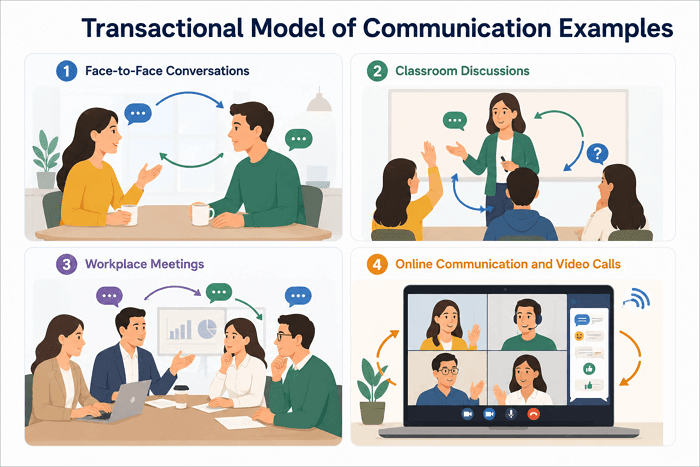
3. Workplace Meetings
The transactional model is also quite relevant in modern workplaces, as they rely heavily on collaboration.
During a project meeting, one team member presents an idea. Colleagues ask follow-up questions, suggest improvements, and raise potential challenges. Based on this feedback, the presenter clarifies certain points or modifies the proposal.
Managers also observe employees’ reactions while discussing deadlines or new strategies. If people seem uncertain, they may need to provide additional explanations or examples.
This continuous exchange helps teams make better decisions, solve problems faster, and avoid misunderstandings before they affect the project.
4. Online Communication and Video Calls
Digital communication follows the same principles, although technology may introduce additional challenges.
For example, during a video conference, participants still exchange messages and feedback through speech, facial expressions, chat messages, and screen-sharing tools. However, internet delays, muted microphones, frozen video, or poor connections may interrupt the flow of communication.
Limited body language can also make it harder to interpret emotions or intentions. As a result, participants often rely on verbal clarification to avoid misunderstandings.
Despite these challenges, online meetings remain highly interactive. Every question, response, emoji, or chat message contributes to the ongoing communication process.
This shows that the transactional model of communication applies just as much in virtual environments as it does in face-to-face conversations.
Advantages and Limitations of the Transactional Model
Like every other communication theory, the transactional communication model is also not perfect. It has its own strengths and limitations, and understanding them can help you apply the model better in different situations.
✅ Advantages of the Transactional Model
The model is widely accepted in communication studies because it reflects how people actually talk to one another. It also:
- Encourages continuous feedback and interaction.
- Considers context, emotions, and relationships.
- Helps reduce misunderstandings through immediate responses.
➖ Limitations of the Transactional Model
This model has a few limitations when communicating. It is:
- Less suitable for one-way communication, such as broadcasts.
- Difficult to analyze as multiple elements occur simultaneously.
- Harder to apply when communicating with very large audiences.
Conclusion
There is more to communication than simply delivering information. You must understand how people respond, adapt your message, and recognize how context may influence the conversation.
No matter the situation, the transactional model of communication helps you communicate more effectively by focusing on continuous interaction instead of one-way messaging.
If you’re preparing presentation slides, you can make use of tools like AiPPT.com to create well-structured ones, making it easier for your audience to understand and provide feedback.
More About the Transactional Communication Model
Knowing how transactions in communication work comes in handy in everyday life. Here are some other things you should also know about the concept.
1. What is a transactional model of communication?
This model basically describes communication as an ongoing process in which people simultaneously send, receive, and interpret messages.
Every participant has an influence on the conversation through spoken words, body language, emotions, and feedback. This makes communication a shared experience rather than a one-way delivery.
2. Why is the transactional model of communication important?
It explains communication more realistically than one-way models because it recognizes the role of feedback, context, relationships, and communication barriers.
The transactional model also helps people improve conversations, teamwork, presentations, negotiations, customer interactions, and classroom learning by encouraging continuous engagement between participants.
3. What is the difference between the transactional and interactive models of communication?
The interactive model views communication as a back-and-forth exchange where participants take turns sending and receiving messages.
However, the transactional communication model is quite different. Here, communication happens simultaneously. People continuously communicate through speech, expressions, gestures, and feedback instead of waiting for their turn to respond.