A group discussion is a structured session where participants share ideas on a particular topic. Knowing how to start a group discussion confidently can help you stand out in interviews, workshops, classrooms, or team meetings. However, many participants hesitate at the start because they worry about saying something wrong or dominating the conversation.
If you often feel this way, the problem may not be confidence, but a lack of a clear strategy for opening the discussion.
In this guide, you will learn practical tips and examples of opening lines for GD. We also cover simple strategies to help you start group discussions effectively.
Key Group Discussion Tips for a Strong Start
The opening of any group discussion should briefly introduce the topic and invite others to contribute and share their perspectives.
Here are some group discussion tips to guide you:
| Tip | How to Apply it |
| Be clear and concise | You don’t have to over-explain yourself. Instead, state your opening point directly and stick to a structure. |
| Use a relevant opening | Ensure that your first words connect to the topic. This helps your audience trust you right from the start. |
| Use a confident tone | Ensure that you speak with purpose, even if you’re nervous. Also, pay attention to your body language, as this can help show authority. |
How to Start a Group Discussion
As we mentioned already, starting a group discussion becomes easier when you follow a simple structure and stick to it.
The exact approach may vary depending on the setting.
- In interviews, you want to show clarity and leadership.
- In classrooms, the focus is on collaboration and learning.
- In workshops or team meetings, the goal is to encourage idea sharing and problem-solving.
Wondering how to initiate a group discussion? Follow these quick steps:
Step 1: Introduce The Topic
Briefly state the topic so everyone clearly understands what will be discussed in the session.
Step 2: Provide Brief Context
Follow up with a short explanation or background to show that you understand the topic.
Step 3: Highlight Key Dimensions
Provide a few perspectives to help guide the discussion. For example, you can mention the pros and cons or causes and effects of the topic under review.
Step 4: Invite Participation
Encourage others to contribute ideas to keep the discussion interactive.

Five Useful Opening Lines to Start a Group Discussion
There are different opening styles for group discussions, and choosing the right one can make your conversation more engaging.
Below, we explore five types of opening lines — with examples and when to use them:
1. Definition or Rephrasing
One of the simplest ways to begin a group discussion is by restating or defining the topic. This approach allows you to clarify the topic and ensure everyone has an idea of what will be discussed.
It comes in handy when you need to introduce topics that contain technical or complex terms, like in academics.
Example:
“Today, we’ll be talking about climate change and its effects. Climate change refers to long-term shifts in temperature and weather caused mainly by human activities. Let’s discuss how it impacts our environment.”
2. Opinion or Personal View
Another approach that also works when starting a GD is by sharing a brief perspective about the topic.
This opening style is ideal in interview settings or debates where you can show confidence by simply taking a stance.
Example:
“In my opinion, technology has significantly improved how students access information and learn new skills.”
3. Context or Background
You may also start a group discussion by explaining the broader context of the topic. By providing a context, you can help members of your group understand why the topic matters.
This approach proves effective when the topic requires situational framing first.
Example:
“Digital learning platforms like Teams and Google Classroom have become common in schools and universities, changing how students access resources and collaborate. We’ll examine whether these platforms truly improve student performance.”

4. Question-Based
Every question needs an answer, and that’s what makes this approach perfect for inviting engagement. Opening your GD with a question makes it interactive right from the start.
It is perfect for workshops or classroom discussions where you need to draw everyone in.
Example:
“Today’s topic is technology in the classroom. Do you think it has improved or distracted students in the classroom? I’d like to hear your opinions on both the benefits and challenges it brings.”
5. Scenario or Hypothetical
If you want, you can also introduce a group discussion topic using a short scenario or example. This approach comes in handy when discussing policy or creative topics, because it encourages imagination.
Example:
“Imagine a city where all cars are electric. How would this shift affect the environment, commuting, and the economy?”
How to Maintain Flow After Starting a GD
Now you know how to start a GD — but it doesn’t end there. How do you keep the momentum going so the discussion stays engaging?
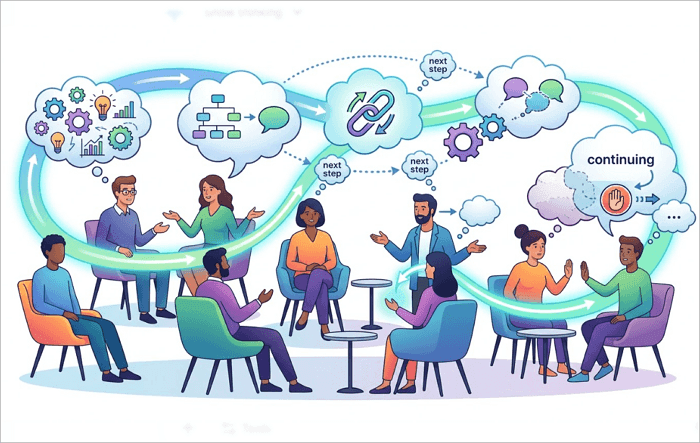
Let’s quickly explore various ways to maintain flow after starting a group discussion:
✅ Paraphrase others’ points: For example, you might say, “That’s an interesting perspective, and it connects with the earlier point about digital learning.”
✅ Use transitional phrases: You can easily connect ideas by using statements such as “building on that…” or “another thing to consider is…”
✅ Engage quieter members: Dominating the discussion is something you should avoid, as it can easily discourage others from participating. Invite quieter members to share their thoughts on the topic, too.
✅ Manage interruptions politely: If someone cuts in while you speak, a calm “Let me just finish this point and then I’d love your input” keeps things on track without creating tension.
Common Mistakes When Starting a Group Discussion
Many speakers go to great lengths to prepare for group discussions, but still make mistakes while doing so.
In this table, we cover common errors you can make while starting a GD and how to avoid them.
| Mistake | Fix |
| ⚠️ Jumping in without context | Take 10-15 seconds to provide background for the topic before sharing your opinion. |
| ⚠️ Speaking vaguely | Prepare key points beforehand and be specific with them to show that you understand the topic. |
| ⚠️ Ignoring the views of others | Phrase your opening statement to invite responses from everyone. |
| ⚠️ Misusing filler phrases | Use transitional words sparingly so they don’t make up the bulk of your discussion. |
Conclusion
As a student or professional, knowing how to start a group discussion is a valuable skill you should have. It helps build credibility, demonstrate leadership, and shape how the conversation flows.
If you’re looking to improve, the best way to do so is through practice. Prepare a list of opening lines, rehearse them aloud, and participate in mock discussions.
The more you practice, the more natural your ability to start a group discussion becomes.
Frequently Asked Questions About Group Discussion
Let’s quickly explore other aspects of starting group discussions that you should also know.
1. How to do a group discussion in an interview?
In interviews, group discussions evaluate communication skills, teamwork, and critical thinking.
Here’s how to approach a group discussion in an interview:
- Listen carefully to the topic.
- Organize your thoughts.
- Provide a clear opening statement.
- Avoid dominating the conversation and acknowledge others’ ideas.
2. How to speak in a group discussion in college?
Group discussions in college are a bit different from interviews. However, these sessions also focus on clarity and confidence.
To speak in a group discussion in college:
- Prepare basic knowledge about common topics.
- Practice expressing ideas briefly.
- Listen to other participants.
- Respond thoughtfully.
- Avoid interrupting.
3. How to write a group discussion example?
To write a group discussion example, structure it like a script:
- Introduce the topic.
- Assign different perspectives to different participants.
- Show how they respond to each other.
- Include a conclusion or summary.
- Label each speaker’s contribution and show how ideas build on one another.
This format is useful for training materials, academic assignments, or GD preparation guides.