People often see communication as simply speaking or writing, but in reality, it is a process made up of multiple parts that must work together. These parts are called elements of the communication process, and a breakdown of one of them can lead to misunderstanding.
When this happens, it’s usually because the message is unclear, the wrong channel was used, or the receiver interpreted it differently from what was intended.
Whether you’re preparing for an interview, leading a meeting, or delivering a presentation, you must understand these communication elements to get your message across clearly.
💡 Key Takeaways:
- The elements of communication include sender, message, encoding, channel, receiver, decoding, feedback, noise, and context.
- Each element determines how meaning is understood.
- Understanding how these parts work together helps you avoid common communication breakdowns.
1. What are the Elements of the Communication Process
Communication is a system where the failure of one part can affect the entire message. So the components of the communication process must work together for effective understanding.
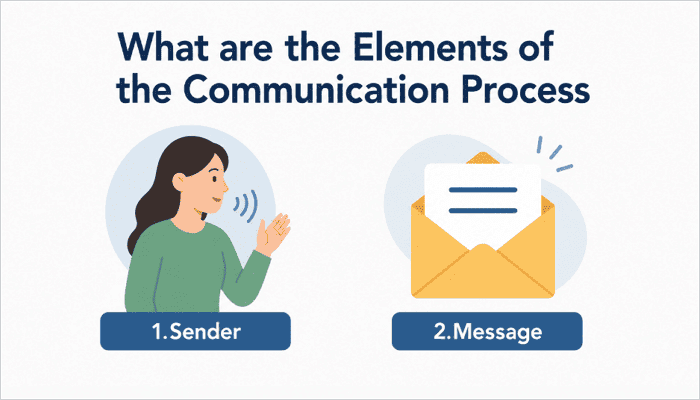
1. Sender
The sender is the one who initiates communication—and frames it for someone else to understand.
As the sender of a message, you shouldn’t assume that your audience already knows the topic or use vague or overly technical language. Instead, you should think about their perspective before deciding how to deliver it.
2. Message
The message is the information the sender wants to communicate and may include ideas, instructions, emotions, opinions, or requests. However, clarity is important in a message to avoid confusion.
For example, compare “Submit your report by Friday at 3 PM via email” with “Send your work soon.” The first message is clearer because it is specific, actionable, and easier to understand.
3. Encoding
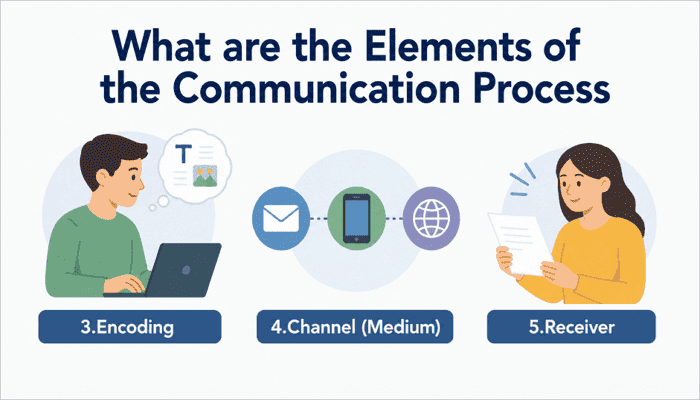
This process is basically how people turn thoughts into words, visuals, gestures, or symbols before communicating. The same idea can be encoded in many ways, which directly affects how others interpret it.
For example, a complex business idea could be encoded as a long email, a spoken explanation during a meeting, or a structured slide deck.
4. Channel (Medium)
The channel is the method you use to deliver the message. It may be face-to-face conversations, emails, phone/video calls, presentations, or social media. However, each channel works best for certain situations.
An example is presenting data-heavy insights as a visual slide deck rather than a quick chat on social media.
5. Receiver
Communication doesn’t end when a message is sent. There must be a receiver who interprets and responds to it.
Attention, experience, emotions, and the receiver’s prior knowledge could influence how they understand the message, which is why different people may interpret the same message differently.
6. Decoding
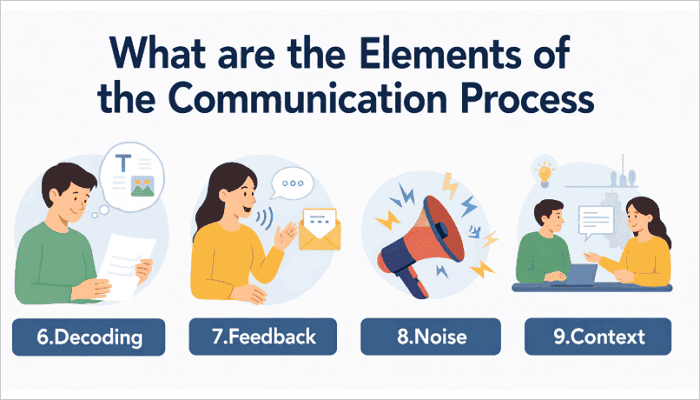
When the receiver gets a message, they have to interpret it. This process is called decoding, and it is one of the key elements of communication.
However, there may also be challenges in decoding, such as unfamiliar language, cultural differences, or unclear expressions. If a sender uses too much jargon, the audience may decode the message incorrectly.
7. Feedback
One of the most important elements in communication is feedback, the receiver’s response to a message that tells the sender whether it was understood correctly.
It can come as questions, facial expressions, or comments in presentations, or a colleague summarizing what was discussed in a meeting.
8. Noise
Some elements, such as noise, may interfere with the communication process. Noise may be physical (background distractions), psychological (stress, assumptions, and emotional barriers), or technical (poor internet or device issues).
Recognizing and minimizing these barriers is an important step toward more effective communication.
9. Context
Context is the environment where communication happens. It includes the physical surroundings, social relationships, culture, and organizational environment.
The same message can produce different results depending on context. For example, corporate environments require formal language, which may be unnecessary in casual conversations.
2. Explain the Elements of the Communication Cycle
You already know the various elements of communication. Now, it’s time to see how they all connect in a single cycle.
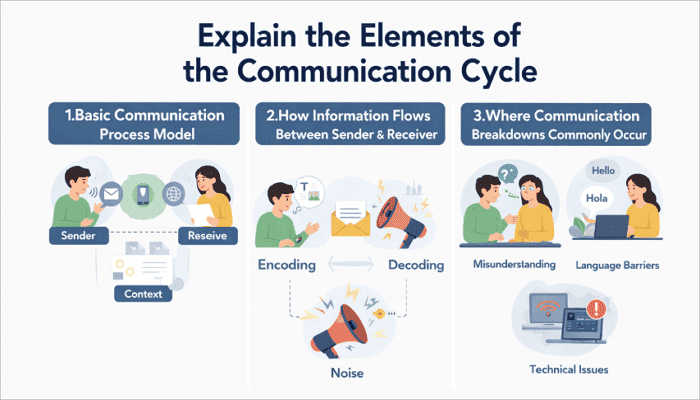
1. Basic Communication Process Model
The sender encodes a message and sends it via a channel, which the receiver decodes and sends feedback. This feedback becomes a new message, which the initial sender receives and responds to. Then, the cycle continues in that way.
2. How Information Flows Between Sender and Receiver
Information changes as it moves through each stage in the communication process. The sender’s intent might be filtered depending on how they choose to encode the message, the channel they use, and how the receiver interprets it, and this explains why communication is described as dynamic.
3. Where Communication Breakdowns Commonly Occur
Breakdowns occur when the sender fails to express their message clearly, the wrong medium is used, or the receiver interprets it differently. In most cases, noise and the absence of feedback also increase the risk of misunderstanding.
3. How to Improve the Communication Process
To improve communication, you need to pay attention to each stage and strengthen individual elements in the process.
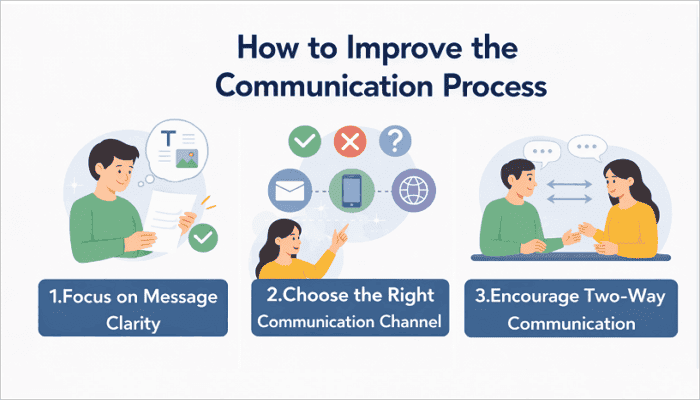
1. Focus on Message Clarity
Understand what you want the other person to know or do. Then, organize your ideas logically, remove ambiguous language, and avoid burying the main point.
2. Choose the Right Communication Channel
Always match the channel to the message type to make it more comprehensible. For example, use:
- Face-to-face conversations or video calls for sensitive discussions.
- Structured presentations for complex ideas that require visual support.
- Email when you need a written record.
3. Encourage Two-Way Communication
Communication works best when both sides participate. Build in moments for questions, invite responses, and practice active listening. In a presentation, this might mean pausing to ask if the audience has questions or incorporating polls.
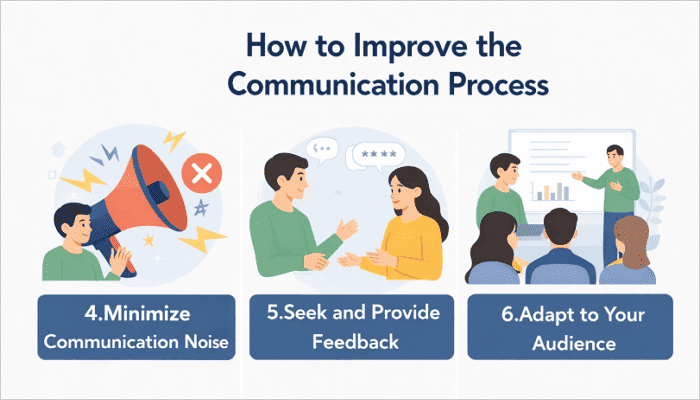
4. Minimize Communication Noise
You may not be able to avoid distractions every time, but you should be able to identify and address them proactively. For workplace conversations, this means choosing the right time and setting.
5. Seek and Provide Feedback
As mentioned earlier, feedback is important. You might ask what was most useful at the end of a presentation or follow-up after sending a complex message. When you are the receiver, summarize your understanding before responding.
6. Adapt to Your Audience
Communication should always be designed for the receiver. Adjust your language, tone, examples, and delivery based on who you’re talking to. A senior executive, for example, would require a different communication style than a student audience.
Conclusion
Communication problems rarely happen due to bad intentions, but often from a breakdown in one part of the process.
However, you can easily diagnose what went wrong and address the problem when you understand the elements of the communication process. They are necessary for effective communication in business meetings, classroom presentations, and everyday conversations.
In your next presentation, use what you now know about encoding, channel selection, and audience adaptation to build slides that don’t just display information, but actually communicate.
FAQs on Components of the Communication Process
Still have questions about how communication works? Here are answers that help clarify parts of communication and how they function in real scenarios.
1. What are the various elements of the communication cycle?
The elements of communication include the sender, message, encoding, channel, receiver, decoding, feedback, noise, and context. These elements create a loop, allowing both parties to confirm understanding and adjust their communication accordingly.
2. What are the 8 major elements of the communication process?
The 8 major elements of the communication process are:
- Sender: The person who initiates the message.
- Message: The content or idea being shared.
- Encoding: Conversion of thoughts into words, visuals, or symbols.
- Channel: The medium used to deliver the message.
- Receiver: The person who receives and interprets the message.
- Decoding: The process of interpreting the message.
- Feedback: The receiver’s response, which confirms whether the message was understood.
- Noise: Any barrier that interferes with communication.
3. What are the 7 elements of the communication process?
In some models, the communication process is broken into 7 elements, which typically omit either context or noise. They include:
- Sender: The originator of the message.
- Message: The idea or information being communicated.
- Encoding: Translating the idea into a communicable form.
- Channel: The medium used to carry the message.
- Receiver: The recipient of the message.
- Decoding: Receivers interpret the message.
- Feedback: The response that closes the communication loop.