Like its beginning, the end of a presentation matters a whole lot. It leaves a lasting impression on your audience, so it should be crafted carefully.
Your final words are often what people remember on the way out of the room. They shape how well they understand your main message and even what they do next. Many speakers end with “That’s all” and shuffle back to their seats, which can be really awkward.
In this article, we’ll explore practical ways to create a stronger ending and avoid an awkward finish like this.
What Makes a Great End of Presentation?
A good ending to a presentation does more than just signal that your slides are finished. It gives your audience a clear final thought and a reason to remember your message.
Here are four principles to keep in mind when preparing a presentation conclusion:
✅ Make Your Key Message Unforgettable: Bring your central idea back into focus instead of introducing new information.
✅ Leave Your Audience with Something to Remember: A question, story, statistic, or strong statement can give your ending more impact.
✅ Keep Your Ending Consistent from Start to Finish: Your closing should connect naturally with the purpose and structure established at the beginning.
✅ Give Your Audience a Reason to Act: If your presentation asks people to change, decide, buy, or try something, make the next step clear.
How to End the Presentation in 12 Effective Ways
There are many ways to end a presentation, with the best approach depending on your audience, subject, and goal. Here are 12 techniques you can use, along with an explanation of how they work.
1. End with a Call to Action
A call to action works well when your presentation is trying to persuade, sell, or encourage change. It helps tell the audience exactly what you want them to do after listening to your presentation.
A marketing presentation could finish with: “Review your current campaign this week and identify one channel that needs a fresh approach.”
2. Return to Your Opening
In some cases, you may want to create a full circle in your presentation by returning to something from your introduction. You could revisit an opening question, story, image, or surprising fact.
For example, if you started a presentation about productivity by asking, “What could your team accomplish with one extra hour every day?” you could return to that question at the end.
3. Summarize Your Key Message
A summary can also come in handy, but it doesn’t mean repeating every point from your slides. Instead, you can just highlight one or two ideas you want the audience to remember.
Try: “If there is one thing to take away today, it is this: simplify the process before adding more tools.”
4. Ask a Thought-Provoking Question
You can use a question to keep your audience thinking even after you leave the stage. However, you want to ask one that connects directly to your key message.
Try something like, “What would change in your team if this problem disappeared tomorrow?
5. Share a Memorable Quote
A relevant quote can provide an extra layer of meaning to the end of your presentation as long as it supports your main argument instead of simply sounding generic.
For example, you can end a presentation or speech about learning with a short quote about curiosity or continuous improvement.
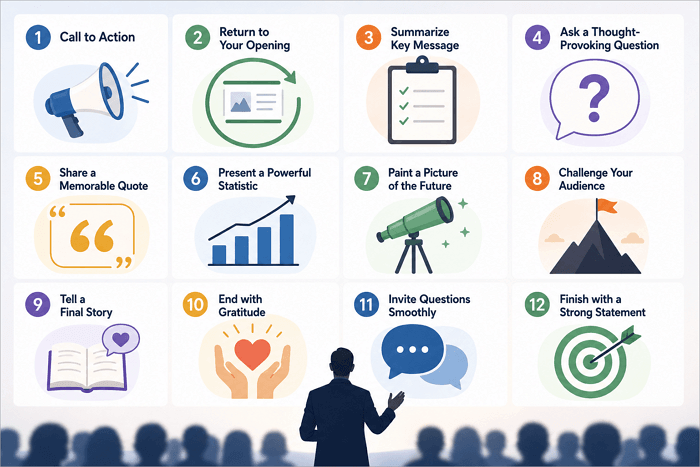
6. Present a Powerful Statistic
Want to give your audience something concrete to remember? Sharing a striking statistic while closing the presentation can help you do that.
Assuming you’re delivering a presentation about customer experience, you might end with a statistic showing how customer expectations have changed over time.
7. Paint a Picture of the Future
This approach works particularly well for presentations about innovation, business growth, technology, or long-term goals. You can use it to describe what the future could look like if your audience takes the right steps.
For example: “Imagine opening this report six months from now and seeing that the process that once took two days now takes two hours.”
8. Challenge Your Audience
Rather than ending with the regular “thank you” slide, challenge your audience by asking them to do something specific or reconsider an assumption. This can make your outro more engaging.
In a classroom presentation about sustainability, you could say: “Before you leave today, choose one habit you can change this month.”
9. Tell a Final Story
A short story can bring your message to life. It might be a customer experience, classroom example, case study, or personal observation. However, ensure that your story simply reinforces the message and does not introduce an entirely new topic. This way, the audience can quickly understand the idea behind it.
10. End with Gratitude
You can never go wrong with thanking your audience after you finish a presentation or speech. It’s perfect for conferences, classroom presentations, team meetings, and formal events. What makes it effective is how you do it.
Instead of automatically saying “Thank you for listening,” make the gratitude specific: “Thank you for taking the time to explore this idea with me today.”
11. Invite Questions Smoothly
A lot of speakers struggle while transitioning to Q&A. Usually, this happens because they don’t give their audience a clear invitation to ask questions.
You could say, “That brings me to the end of my presentation. I’d be happy to hear your questions or discuss any part of the proposal further.”
12. Finish with a Strong Statement
Sometimes, a strong final statement may be all you need. Luckily, it’s very easy to adapt regardless of the topic.
For a business presentation, you may close with “The opportunity is clear. Now we need to decide whether we are ready to act on it.”
50 Closing Lines for Every Presentation
Sometimes you know exactly what you want to say but cannot find the right words. The examples below can help you choose a presentation ending speech that fits your topic and audience.
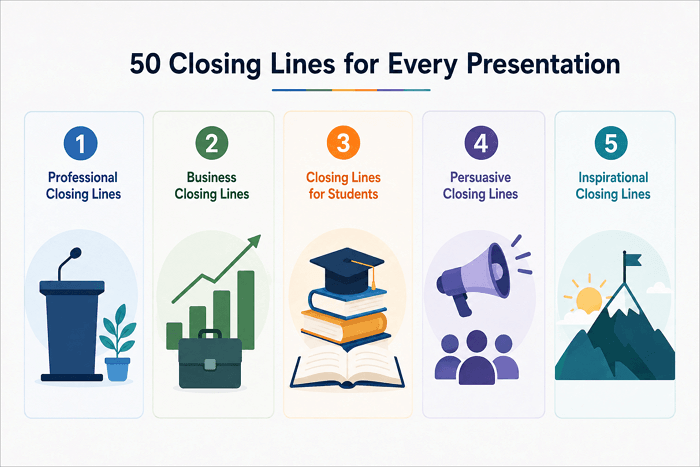
1. Professional Closing Lines
- Thank you for your time and attention today.
- I appreciate the opportunity to share these ideas with you.
- That brings us to the key takeaway from today’s discussion.
- Thank you for being part of this conversation.
- I hope this gives you a useful perspective to take forward.
- That concludes my presentation. Thank you for listening.
- I appreciate your attention and look forward to the discussion.
- The next step is clear, and we are ready to take it.
- Thank you for your time. I’m happy to take your questions.
- Let’s take this conversation from ideas to action.
2. Business Presentation Closing Lines
- The opportunity is in front of us. Now it is time to act.
- With the right strategy, this goal is within reach.
- The numbers tell a clear story: there is room to grow.
- Our next step is to turn this plan into measurable results.
- We have identified the challenge; now we can focus on the solution.
- The decision we make today can shape our results tomorrow.
- This is more than a proposal; it is an opportunity to move forward.
- Let’s turn these insights into our next business decision.
- The strategy is ready. Now we need to put it into practice.
- Thank you. I look forward to building the next stage together.
3. Presentation Closing Lines for Students
- Thank you for listening to my presentation.
- I hope you learned something new from this topic.
- That is why this topic deserves more attention.
- Now that we understand the problem, we can think about possible solutions.
- I hope this presentation gave you a clearer view of the subject.
- Those are the main points I wanted to share today.
- Thank you for your attention. I’m ready for your questions.
- The key lesson is simple: small changes can make a difference.
- I hope you leave with one idea you can remember.
- That brings my presentation to an end. Thank you.
4. Persuasive Presentation Closing Lines
- The question is no longer whether change is needed, but when we begin.
- If we want different results, we need to be willing to try something different.
- The choice is ours, and the next step starts today.
- Think about what could change if we acted on this idea.
- Now that you know the facts, what will you do with them?
- The evidence gives us a direction; action will give us results.
- Change begins when an idea becomes a decision.
- The opportunity is here. The next move is up to us.
- Let’s not simply discuss the solution. Let’s start using it.
- I encourage you to question the usual approach and consider a better one.
5. Inspirational Closing Lines
- Progress begins with one decision to move forward.
- A better future starts with the choices we make today.
- The first step may be small, but it can change the direction ahead.
- Ideas create possibilities; action turns them into results.
- You do not need to change everything at once. Start somewhere.
- The future is shaped by what we choose to do today.
- Keep the idea, question the limits, and take the next step.
- What happens next depends on what we do with what we have learned.
- Let this be the beginning of the next conversation, not the end.
- Thank you—and I hope you take this idea with you.
Create Better Presentations with AI
Choosing the right ending of the presentation is only one part of creating a strong deck. You also need a clear structure, useful visuals, and slides that support what you say, and AiPPT.com can help with that process.
With AiPPT.com, you can:
- Generate slides from a simple text prompt or idea
- Upload PDFs, Word docs, or TXT files to convert into structured slides
- Convert any webpage URL into an organized presentation
- Access 200,000+ professionally designed templates
- Edit, export, and share finished decks in a few clicks
Here’s how to create a presentation with AiPPT:
Step 1: Create an account on AiPPT.com or sign in if you have one.

Step 2: Enter your topic or upload a document.
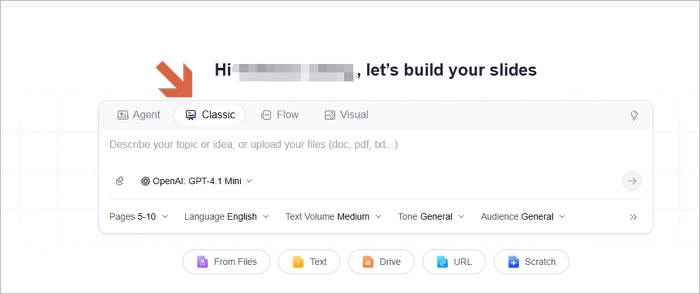
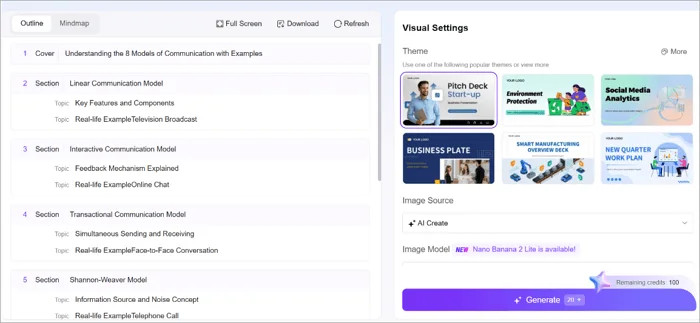
Step 3: Choose a template and generate your presentation.
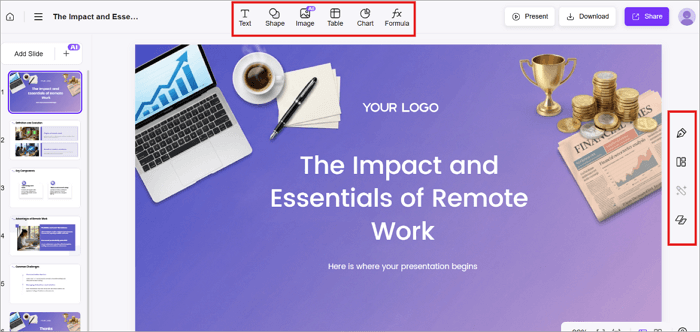
Step 4: Customize the slides from the Insert menu or Design panel.
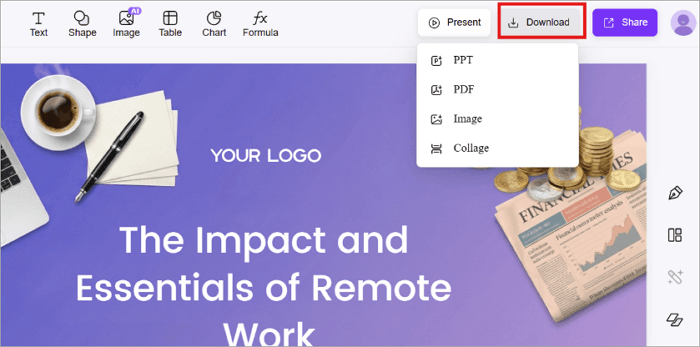
Step 5: Open the Download menu and choose an export format.
Conclusion
The most important thing to keep in mind when preparing an end of presentation is that your final words only need to reinforce the message you want people to remember.
Whichever technique you choose, whether it’s a question, a story, a call to action, or a confident statement, ensure that you treat your close with the same care you gave to your opening slide.
So when preparing your next presentation, write your final sentence before you finish designing the deck. Then practice saying it aloud to hear how natural it sounds.
FAQs on the Ending of the Presentation
Still wondering what the best way to close your presentation is? The answers to these common questions should help you choose better.
1. How to conclude a PowerPoint presentation funny?
Here’s how to conclude a presentation funnily:
- Use humor that relates to your topic
- End with a light observation or a relevant meme
- Give a playful reference to something you mentioned earlier
- Keep it appropriate for your audience
- Ensure that the humor doesn’t distract from your main message
2. How to finish a presentation speech for school?
To wrap up a presentation at school, check out these tips:
- Summarize your main idea in one sentence
- Thank your classmates and teacher for listening
- End with a simple question, memorable statement, or call to action
- Invite questions if your format allows it
3. How to close a presentation as a student?
Here’s how to finish a presentation as a student:
- Remind your audience of your main point
- Choose one simple way to finish
- It could be a thought-provoking question, a relevant fact, or a statement
- If appropriate, thank your audience and invite questions