Communication is important in almost every aspect of life. You have to communicate whenever you need to explain ideas at work, collaborate with your team, teach others, assist customers, or share important updates, but how can you do so effectively?
This brings us to choosing from various communication methods. Problems often come up in communication, not because people lack information, but because the message is delivered through the wrong channel or format.
In this article, we’ll explore the major types of communication, practical examples of when to use them, and simple ways to improve the flow of your message.
Key Takeaways:
- The types of communication include verbal, nonverbal, written, and visual communication.
- Different situations require different communication methods.
- Combining multiple methods often improves understanding.
- Clear organization, active listening, and audience awareness make communication more effective.
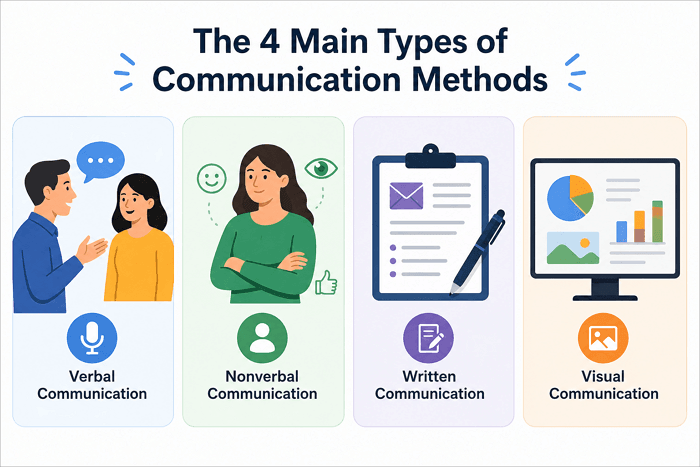
The 4 Main Types of Communication Methods
There are 4 types of communication methods, which act as umbrellas for the different channels you can use. In reality, people rarely stick to one and prefer to combine several methods to get their message across.
1️⃣ Verbal Communication
This is basically the exchange of ideas through spoken words, including conversations, meetings, presentations, interviews, classroom lectures, and discussions. Verbal communication is widely used because feedback comes immediately.
However, this method of communication depends heavily on tone and delivery, meaning you may not achieve your communication goal if you don’t use the right speaking approach.
2️⃣ Nonverbal Communication
While spoken words are important, communication goes beyond them. Facial expressions, gestures, body language, eye contact, and posture influence how people interpret—and understand your message.
For example, maintaining eye contact during a presentation signals confidence and helps build trust with your audience. These nonverbal signals also come in handy during face-to-face conversations, job interviews, classroom teaching, and customer interactions.
3️⃣ Written Communication
In cases where information needs to be recorded, referenced, or shared accurately, written communication is the best method to use. Unlike spoken conversations, written documents can be reviewed later, making them valuable for long-term communication.
Common examples of written communication include emails, reports, business proposals, contracts, meeting notes, and project documentation.
4️⃣ Visual Communication
This method uses presentations, charts, diagrams, images, videos, and other visual elements of communication to explain information more effectively.
People generally process visual information much faster than large blocks of text. That’s why businesses, educators, and marketers frequently rely on them to make complicated information easier to understand.
Different Communication Methods with Examples
People use different methods of communication every day. And in many cases, the same type of communication can appear through different channels, depending on the situation, audience, and purpose.
1. Face-to-face Communication
Direct conversations between people remain the most valuable method of communication, even with the introduction of modern digital tools. Many people prefer it because it allows people to exchange ideas while observing facial expressions, gestures, and tone of voice.
All of these make face-to-face communication the ideal option for building relationships, resolving conflicts, negotiating agreements, or providing detailed feedback on a product or service. Since participants can respond immediately, it is easier to identify and resolve misunderstandings.
For example, you, as a manager, will achieve better results when reviewing and discussing a team member’s performance in an in-person meeting than by sending a lengthy email.
2. Phone Communication
You may not always have the opportunity to meet someone in person and still need to pass a message across to them. Situations like this are when phone calls become quite useful, allowing you to share information regardless of location.
Although it lacks visual cues, phone communication provides immediate interaction, making it more effective than text-based communication for many situations. For example, when you need a stakeholder to make a quick decision, when a customer issue needs immediate attention, or when a discussion is too complex to be sent via text.
However, phone communication also has limitations. There are no facial expressions or body language, which means you must speak clearly and listen carefully to help reduce misunderstandings.
3. Email Communication
As a professional, one of the most common ways you’ll communicate with coworkers is through email, and this is because it offers something that phone calls don’t. Email allows you to send detailed information, attach files, communicate across different time zones, and maintain a searchable record of conversations.
Unlike face-to-face discussions or phone calls, emails give recipients time to read, review, and respond thoughtfully. This makes them ideal when information must be accurate or shared with multiple people, such as project updates, meeting invitations, reports, business proposals, policy announcements, and customer support.
However, because there is no immediate interaction after sending an email, your message must be clear. A well-written email should include:
- A clear subject line
- A concise introduction
- Organized paragraphs
- Action items or next steps
- A professional closing
4. Digital Communication Platforms
Today, many workplaces rely heavily on digital platforms for everyday communication. Messaging applications, video conferencing software, project management tools, and collaborative workspaces have transformed how teams communicate across different locations.
Platforms like Slack, Microsoft Teams, or Zoom let people send quick updates, collaborate on shared documents, or hold meetings across time zones without picking up the phone.
Digital communication increases speed and accessibility, but it also creates new challenges. Constant notifications, unclear messages, and information overload can reduce productivity if communication isn’t managed carefully.
How to Make Communication More Effective
You need to go beyond knowing the various types and modes of communication and also learn how you can make your message more understandable for the audience. This is what makes communication effective.
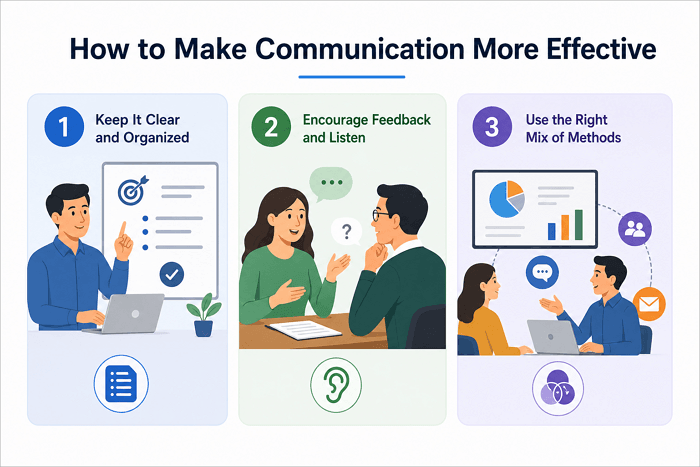
Step 1. Keep Your Message Clear and Organized
There must be a clear objective when you’re speaking, presenting, or sending an email to a person. Identify this objective first, then organize your information in a logical order so each idea naturally leads to the next.
Step 2. Encourage Feedback and Active Listening
Communication is a two-way process, and therefore, you should take time to understand how your audience responds. Encourage questions, listen carefully, invite feedback, and confirm that everyone understands the key points before moving on.
For example, after presenting a proposal, ask your audience to raise any concerns. This can help identify misunderstandings before they become larger problems.
Step 3. Use the Right Combination of Communication Methods
Messages tend to have a greater impact when they are delivered using a combination of communication methods.
For instance, you might introduce a new project during a team meeting, explain the details using a presentation, answer questions through discussion, and then send a follow-up email summarizing the key decisions.
Conclusion
It helps to understand various communication methods because they shape how well teams collaborate, how clearly ideas get across, and how easily people trust what they’re being told.
Keep in mind that effective communication is not about using the most popular channel, but choosing the method that best helps the audience receive and respond to the message.
Review your current communication habits, experiment with the different approaches explored here to see which one fits your situation.
FAQs on Methods of Communication
Still have questions about choosing between different communication channels? Here are quick answers to the most common ones.
1. What are the methods of communication?
These are the channels people use to exchange information, ideas, and feedback. Common examples include face-to-face conversations, phone calls, emails, presentations, video conferencing, instant messaging, reports, and visual media.
The best method depends on your audience, purpose, and the level of interaction required.
2. Which is the easiest way of communication?
Many people regard face-to-face conversation as the easiest because it combines verbal and nonverbal cues, allows instant feedback, and clears up confusion in real time.
However, there isn’t a single easiest method because it depends on the situation, and choosing the right method is usually more important than choosing the fastest one.
3. How to choose from various modes of communication?
The most important thing is to match the channel to the message you’re trying to get across. Use:
- Written communication for anything requiring a record or precision
- Verbal or face-to-face methods for urgent or sensitive topics
- Visual communication for complex data
- Digital platforms for quick team updates.
When in doubt, consider your audience, the urgency, and whether you need immediate feedback.