Remember that time you couldn’t get a movie quote out of your head, or when an advertisement gave you goosebumps no matter how many times it aired?
There are several types of figurative language, and one of them most likely made those moments memorable. In addition, these figures of speech help people express emotions and describe ideas creatively.
You want to use words to paint pictures in your audience’s minds? Then you should understand figures of speech and how they are used.
💡 Key Takeaways
- Figures of speech help make your message clear and more memorable.
- Each type works differently: some compare, some exaggerate, and some give human traits to objects.
- Recognizing figures of speech helps you read other people’s writing more critically.
1. What Is a Figure of Speech and Why Do People Use It?
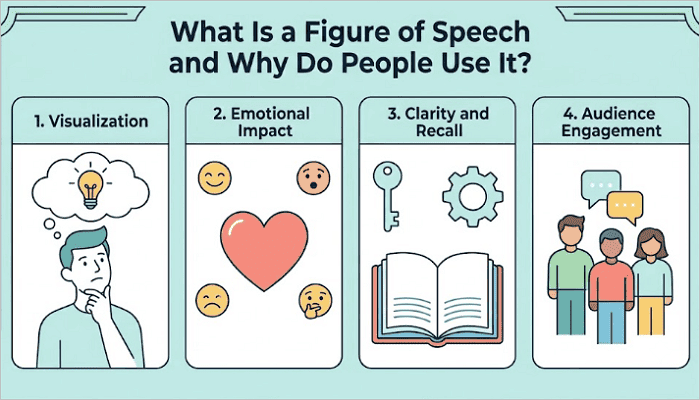
A figure of speech basically involves using words to paint a “figure” so that an audience has a more visual idea of what you’re talking about in their mind. With figures of speech, words are used creatively to express meanings beyond their literal definitions.
For example, “She is very busy”, which is a literal statement, can be expressed using a figure of speech as “She has a million things on her plate.”
People use figures of speech because they add emotion to communication, create vivid images, simplify complex ideas, make messages easier to remember, and make speeches more engaging.
2. Types of Figures of Speech With Their Examples
You can use different types of figurative language in your writing, speeches, presentations, and daily conversation.
Here’s a quick overview covering each one and how they work.
| Figure of Speech | Purpose | Example |
|---|---|---|
| 1. Simile | Makes comparisons using “like” or “as” | Busy as a bee |
| 2. Metaphor | Creates direct comparisons | Time is a thief |
| 3. Personification | Gives human traits to non-humans | The wind whispered |
| 4. Hyperbole | Uses exaggeration for emphasis | I’m starving to death |
| 5. Alliteration | Repeats beginning sounds | Peter Piper picked |
| 6. Onomatopoeia | Imitates sounds | Buzz, Bang |
| 7. Oxymoron | Combines opposing ideas | Bittersweet ending |
| 8. Irony | Contrasts expectation and reality | A fire station burns down |
| 9. Symbolism | Uses symbols to represent ideas | A dove representing peace |
| 10. Repetition | Repeats words for emphasis | Never give up. Never surrender |
1. Simile
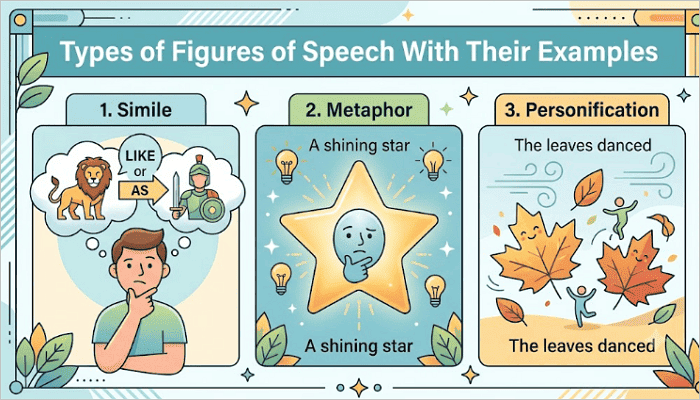
Imaginations shouldn’t be bland, and that’s where similes come in handy. They help people imagine descriptions more clearly by comparing two unlike things using “like” or “as.”
Examples:
- Her smile was as bright as the sun
- He ran like the wind
These comparisons create stronger impressions because they connect unfamiliar experiences with familiar ones. Instead of simply saying someone runs fast, you can use the comparison to help your audience visualize how fast.
2. Metaphor
Unlike similes, metaphors are used to create direct connections between two different ideas—without using comparison words. They often make the most memorable expressions in communication.
Examples:
- The classroom was a zoo
- Life is a journey
Generally, metaphors are useful when explaining emotions or abstract concepts because they simplify them quite well. Saying “life is a journey” suggests growth, obstacles, and experiences without stating them directly.
3. Personification
Just like it sounds, personification “personifies” things. Basically, this figure of speech makes non-human things, such as animals, objects, and ideas, feel more alive by giving them human qualities.
Examples:
- The flowers danced in the breeze
- The alarm clock screamed at me
You’ll frequently come across personification in poetry and children’s stories because it helps audiences build an emotional connection with otherwise ordinary subjects.
4. Hyperbole
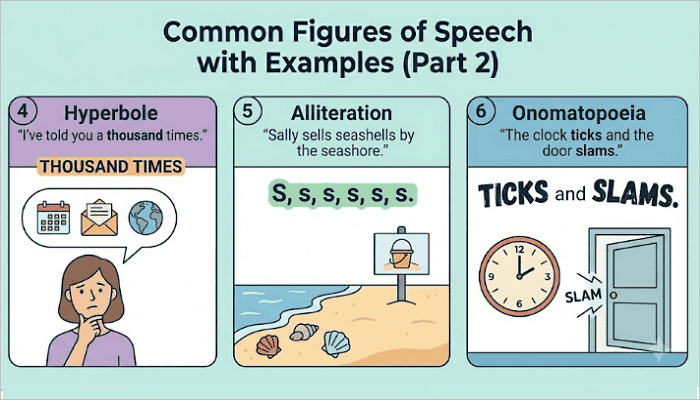
To be hyper means to do too much, and that’s essentially what hyperbole is about. It uses deliberate exaggeration to emphasize feelings or reactions in a message.
Examples:
- I’ve told you a thousand times
- I’m so hungry I could eat a horse
Nobody expects these statements to be true. Their purpose is emotional emphasis rather than factual accuracy. Hyperbole appears regularly in advertisements, creative writing, and conversations because it grabs attention and makes messages more dramatic.
5. Alliteration
Alliteration involves repeating initial consonant sounds, making certain phrases more rhythmic and memorable.
Examples:
- Fantastic Friday deals
- Busy bees buzzed by
Advertisers, marketers, speechwriters, and poets frequently use alliteration to improve rhythm, as seen in brand slogans such as Coca-Cola and PayPal. It also makes statements memorable since people find it easier to remember pleasant sound patterns.
6. Onomatopoeia
This figure of speech uses sound-based words to make descriptions feel more active and vivid. In onomatopoeia, the words imitate actual sounds to help an audience imagine a scene more clearly.
Examples:
- Buzz
- Splash
- Boom
- Tick-tock
Onomatopoeia is frequently used in comics, storytelling, and advertisements as it adds sensory detail that can enhance how well your audience engages with the content.
7. Oxymoron
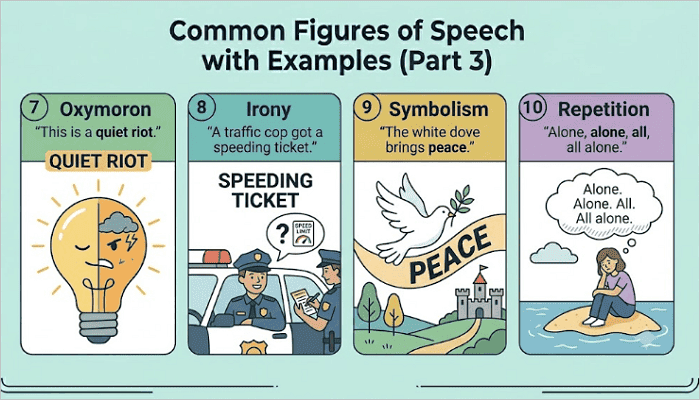
An oxymoron combines two contradictory words into a single phrase. Instead of canceling each other out, both words create a contrast that makes the phrase meaningful.
Examples:
- Organized chaos
- Deafening silence
- Bittersweet ending
These phrases describe moments that are difficult to describe on a normal day. An oxymoron works because real situations are often contradictory too—and this figure of speech exploits that contradiction in two words.
8. Irony
Another one on this figurative language list is irony, which you may have come across at least once. Irony happens when the real meaning of a situation differs from what is said literally, or when an outcome is the opposite of what was expected. This is what makes it tricky for some people.
Examples:
- A traffic officer receives multiple speeding tickets
- Someone posts online about how much they dislike social media
An ironic statement often expresses the opposite of what is true, usually to create a sarcastic effect. Writers also use it to introduce humor, criticism, suspense, or surprise.
9. Symbolism
In symbolism, an object, color, or image is used to represent something bigger than its literal form. While the object may be simple, the meaning it creates is quite significant.
Examples:
- A dove symbolizes peace
- Red often signals danger or urgency
- A heart symbolizes love
Symbolism appears constantly in literature, film, and marketing because one recognizable image can carry an idea that would otherwise take a full paragraph to explain.
10. Repetition
This figure of speech uses repetition of a specific word or phrase to create a structure that builds emphasis, rhythm, and memorability. However, effective repetition reinforces a central idea instead of repeating information without purpose.
Examples:
- Never give up. Never surrender
- We shall fight on the beaches, we shall fight on the landing grounds
Repetition is commonly used in poetry, speeches, and persuasive writing because repeated language tends to stick in an audience’s memory far longer than a single mention.
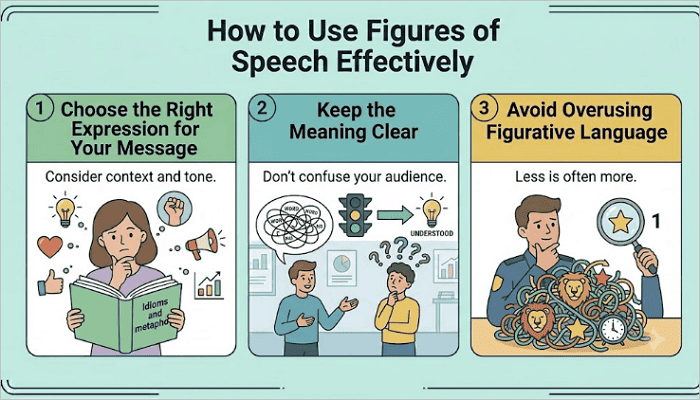
3. How to Use Figures of Speech Effectively
The real value in these figure of speech examples we’ve covered is knowing how to use them to strengthen your message and not to distract from it.
1. Choose the Right Expression for Your Message
Figures of speech are quite varied and therefore may not work for every audience. Always match the type to your purpose.
For example, metaphors and repetition might come in handy when you’re inspiring an audience, but similes and personification will help create a vivid picture when you’re describing an experience.
2. Keep the Meaning Clear
Using words creatively shouldn’t prevent your audience from understanding your message. Confirm that the expression you choose to use is one they will recognize immediately, not one that needs to be explained thoroughly.
3. Avoid Overusing Figurative Language
Use figures of speech selectively in your communication so you don’t overwhelm the audience. They should help you emphasize important ideas, not complicate them further.
Conclusion
These types of figurative language remain important in writing, speaking, storytelling, and marketing because they help people connect with ideas intellectually and emotionally.
However, they are only considered effective when they make ideas clearer and more memorable. It’s more than just sounding sophisticated in English.
Start by identifying figures of speech in advertisements, movies, speeches, and conversations. Then, experiment with them in your own writing and speaking.
Learn More About Figurative Language
Figures of speech may seem complicated at first, but practical examples and regular exposure can help you understand them better.
1. What is a figure of speech in English?
A figure of speech is a creative way of using language to express ideas beyond their literal meanings.
It helps speakers and writers communicate emotions, create vivid images, and make messages more engaging. Common types of figures of speech include similes, metaphors, personification, hyperbole, and irony.
2. What are 7 types of figurative language?
There’s no official number of the different types of figures of speech. However, mastering just a handful of core expressions can dramatically transform your writing. The seven most common types used in daily communication include:
- Simile
- Metaphor
- Personification
- Hyperbole
- Repetition
- Symbolism
- Onomatopoeia
3. How to choose from different types of figurative language?
You should always prioritize the goal of your speech first. If you’re looking to compare two things directly, use a simile or a metaphor.
You can use hyperbole or repetition when you need to emphasize an idea or connect with your audience’s emotions. And if you’re trying to make an object feel alive in a story, personification does that job best.