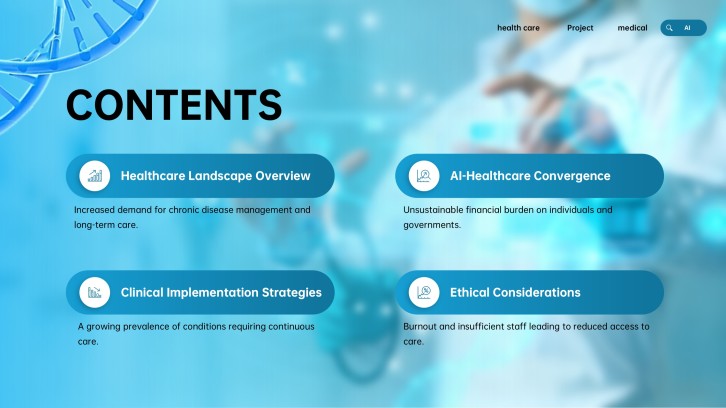
For students, data teams & researchers

Machine Learning Project Presentation Template + AI Generator

Create a clear machine learning project presentation in minutes. Use the AI machine learning project presentation generator to organize your problem, dataset, features, model choices, experiments, metrics, errors, fairness, limitations, and deployment plan.Build machine learning project slides from data, models, experiments, metrics, limitations, and next steps with AI.
Browse Templates
Data and model workflowExperiments and evaluationResponsible ML deployment
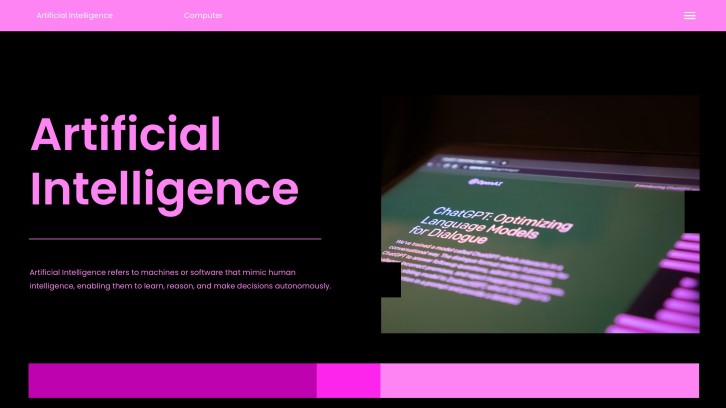
PPT Presentation on Artificial Intelligence in Computer
Data-to-decision slide flow
AI-assisted ML project copy
Editable machine learning templates
Export machine learning project PowerPoint

Related machine learning project presentation resources

How to create a machine learning project presentation

  1. Define the real-world problem, prediction target, users, decision point, scope, and measurable success criteria.
  2. Describe data sources, labels, sampling, cleaning, leakage controls, class balance, privacy, and train-test separation.
  3. Compare a simple baseline with candidate models and justify features, preprocessing, tuning, and experiment design.
  4. Report reproducible metrics, uncertainty, calibration, error cases, subgroup performance, and operational constraints.
  5. Translate results into limitations, monitoring, human oversight, deployment recommendation, and the next experiment.

Example sections in your machine learning project presentation

  • Problem, users, target prediction, baseline process, scope, and success criteria.
  • Dataset, label definition, sampling, cleaning, leakage checks, features, and exploratory findings.
  • Baseline, candidate models, training pipeline, hyperparameters, and validation design.
  • Metrics, confusion matrix, calibration, error analysis, subgroup results, and ablation findings.
  • Limitations, fairness, privacy, deployment architecture, monitoring, recommendation, and future work.

Choose your machine learning project presentation format

Supervised Learning Project

Applicable to:

Classification studiesRegression projectsRisk prediction

Present labels, features, baselines, candidate models, validation, error analysis, calibration, and decision thresholds.

Deep Learning Project

Applicable to:

Computer visionNatural language processingTime-series modeling

Explain architecture, training data, augmentation, compute, optimization, benchmarks, failure cases, and model limitations.

Unsupervised Learning Study

Applicable to:

Clustering analysisAnomaly detectionRepresentation learning

Show feature preparation, similarity choices, cluster validation, discovered patterns, interpretation risks, and downstream use.

Production ML Review

Applicable to:

Deployment reviewsModel monitoringResponsible AI audits

Connect offline evaluation to serving architecture, latency, drift, fairness, human oversight, rollback, and business impact.

Example machine learning project presentation

What makes a machine learning project presentation effective

  • The target, label window, prediction unit, baseline, dataset split, and operational decision are unambiguous.
  • Every metric includes the evaluation set, threshold, uncertainty, and practical meaning for users.
  • Error analysis, subgroup performance, leakage checks, calibration, and limitations are reported honestly.
  • Deployment plans include monitoring, drift, privacy, human oversight, rollback, and named owners.

Common mistakes

  • Reporting high accuracy on an imbalanced dataset without a baseline, class metrics, or decision threshold.
  • Mixing future information into features or tuning repeatedly against the final test set.
  • Showing a complex model without explaining data quality, experiment design, failure cases, or practical value.
  • Treating deployment as a final API call while ignoring drift, fairness, security, monitoring, and human review.

Frequently Asked Questions

Include the problem, target, dataset, features, baseline, model choices, validation, metrics, error analysis, limitations, fairness, deployment, and next steps. Keep a clear trace from the user decision to the evidence supporting the model.
A classroom or capstone review often works well with 10 to 15 slides, while a short demo may use 6 to 8. Reserve enough space for the dataset, experiment design, results, errors, and limitations rather than spending most slides on background.
Choose metrics that fit the task and operational cost. Classification projects may need precision, recall, F1, PR-AUC, ROC-AUC, calibration, and threshold-specific confusion counts; regression projects may use MAE, RMSE, residuals, and comparison with a meaningful baseline.
A strong example defines one decision, prevents leakage, compares with a simple baseline, uses a reproducible test design, explains errors and subgroup results, and ends with a cautious deployment recommendation. The CarePath example above follows that structure for readmission risk prediction.
AI can organize project notes, condense technical explanations, and suggest layouts for a starting deck. You should still verify code, dataset provenance, metrics, citations, privacy, fairness, and every model-performance claim.
Yes. Choose a relevant template, generate a starting structure, and replace the draft with your own data diagrams, model workflow, charts, metrics, experiment details, citations, limitations, and conclusions.
AI Presentation Maker

Generate your machine learning project presentation now

Turn your dataset, model workflow, experiments, results, and deployment plan into a structured machine learning project presentation with AI.