Whether it’s a pitch for a marketing idea, campaign proposal, or product launch, many people struggle to present it clearly.
Your ideas may be great, but they make little impact if you don’t present them properly. You might even lose the audience before you’re able to share those ideas.
However, with a structured marketing deck, you can share them in a way that feels clear and persuasive. It comes in handy in scenarios such as client pitches, internal presentations, and investor meetings.
In this guide, you’ll learn what a marketing deck is, explore marketing deck examples, and follow a step-by-step process to create one.
What Is a Marketing Deck and Its Types
A marketing deck is a visual presentation that communicates a marketing idea, strategy, or campaign to a specific audience.
Instead of discussing long documents, it helps to break down complex strategies into a simple story that is clear and easy to understand.
A marketing deck may be used differently, depending on the context. Sometimes, it’s used to pitch to and win a client. Other times, teams use it to align internal stakeholders around a particular strategy or campaign.
You’ll also find it useful in startup settings, where it can serve as the marketing chapter of a broader investor pitch.
Here are the types of marketing pitch decks and their common use cases.
| Type | Best For | Common Use Cases |
| 1. Marketing Pitch Deck | Persuading external decision-makers | Client acquisition, investor pitches, and agency proposals |
| 2. Marketing Strategy Deck | Aligning internal stakeholders on goals and direction | Quarterly planning, team alignment, and leadership reviews |
| 3. Campaign/Product Deck | Presenting specific initiatives to cross-functional teams | Product launches, campaign kickoffs, and creative briefs |
However, no matter the type, the primary goal of every marketing deck must be to communicate ideas clearly and guide the audience toward a decision.
Key Elements in Good Marketing Deck Examples
How do you know if the marketing deck you just prepared is good enough? Strong marketing deck examples usually contain key elements and tell stories that move from problem to impact.
Let’s explore what these components are.
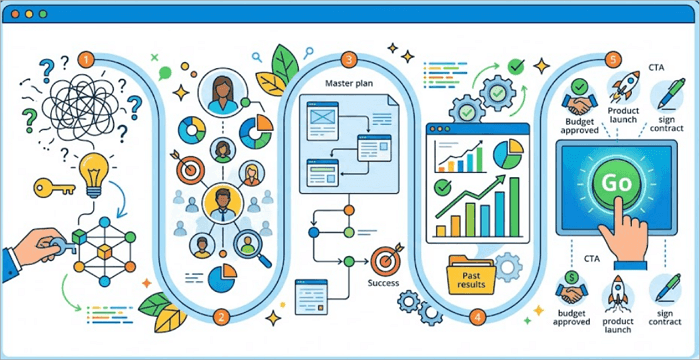
1. Problem and solution framing
A great marketing deck begins with a clear definition of the problem. This helps your audience understand the purpose of the presentation before you provide a solution that explains the proposed campaign, strategy, or idea.
2. Audience definition
There is no marketing without a target audience. So it’s important to make it clear who you plan to reach with your marketing strategy.
Whether it’s a consumer segment or a business buyer persona, this specificity tells anyone watching your presentation that you’ve done the work and aren’t just guessing.
3. Strategy
Your strategy shows how you plan to achieve the marketing goals you have set. It outlines channels, messaging, and execution. However, a good marketing deck should have a concise strategy and avoid unnecessary details.
4. Proof
Another important element of an effective marketing deck example is data to back it up. Include relevant metrics, past campaign results, or case studies to make your deck credible.
It’s best practice to use visuals when presenting data and supporting key points.
5. Call to Action
Finally, your marketing deck should end with a clear call to action for the audience. It may be approving a budget, scheduling a follow-up, signing a contract, or giving the go-ahead for a product launch.
How to Make a Marketing Pitch Deck
Building a marketing pitch deck from scratch without a clear structure can feel overwhelming. So we’ve prepared a step-by-step approach you can use to create one easily.
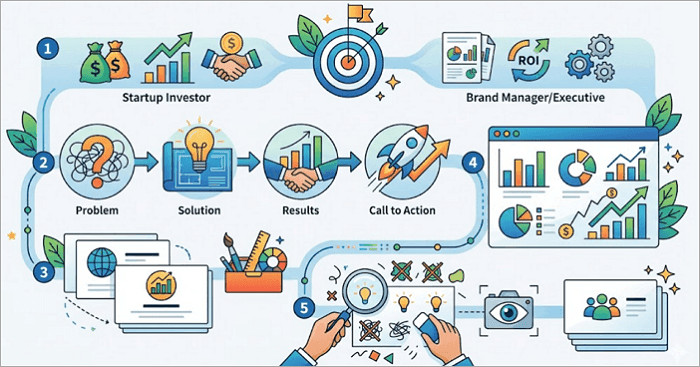
Step 1: Define Goal and Audience
Before you start building, you need to identify the purpose of your marketing deck. This shows what you want to achieve and keeps you in line with that purpose.
Next, think about the audience you’re building for. A marketing pitch deck for a startup investor should be different from the one you present to a brand manager.
Investors want to see growth potential, while executives want results and ROI.
Step 2: Build a Clear Structure
The next thing is to map your story so that it follows a logical flow:
- Problem
- Solution
- Results
- Call to action
With a structure like this, it’s easier for your audience to progress with the narrative of your pitch deck.
Step 3: Design Simple, Clean Slides
When it comes to slide design, less is usually more. Ensure that the design you use supports the message and does not distract your audience from it.
Use short headlines, minimal text, and clear visuals so you don’t lose their attention quickly. Also, try sticking with the same fonts, colors, and layout throughout the deck.
Step 4: Add Data and Proof
As we mentioned earlier, numbers and data make your marketing deck even more credible. Include metrics such as:
- Market size
- Conversion rates
- Post-campaign results
- ROI
- Growth projections
To make your data easier to understand, visualize it with charts rather than long paragraphs or tables.
Step 5: Refine and Remove Unnecessary Content
After creating a first draft, take some time to review and remove anything that doesn’t support your core message. To spot this quickly, read through like an audience member would, not like a creator.
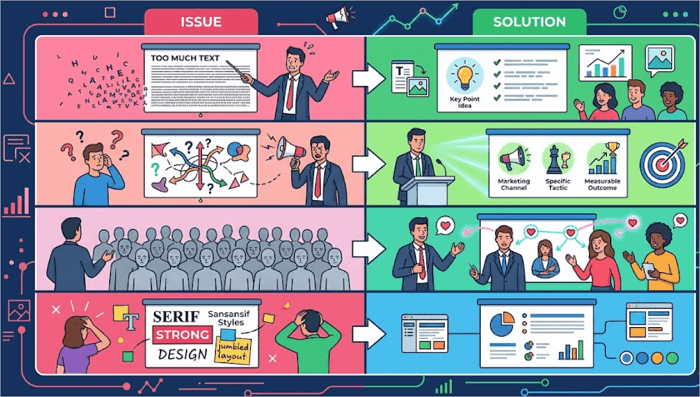
Marketing Deck Issues and Solutions
Still having issues with your marketing deck? Here are the most common ones and how to fix them in no time.
1️⃣ Too much text
When you pack your slides with paragraphs, they overwhelm the audience and become hard to read.
Fix: Reduce each slide to one key point. Also, use bullet points instead of full sentences and integrate visuals to support your message.
2️⃣ Weak or unclear messaging
If your audience doesn’t understand the main point of your deck, then there’s an issue.
Fix: Be specific when giving details. Name the marketing channel, tactic, and measurable outcome of the project.
3️⃣ Lack of audience focus
A deck without audience focus feels generic and, as a result, becomes less persuasive.
Fix: Tailor the content to your specific audience so they can quickly connect with your story.
4️⃣ Inconsistent design
When you use mismatched styles, fonts, colors, or layouts on the same slide, it distracts from the content and makes it look unprofessional.
Fix: Use or download AiPPT templates for consistency.
Conclusion
A strong marketing deck does more than present ideas. It helps outline strategy and influence decisions, whether it’s winning a client or aligning a team.
While building your marketing pitch deck, remember to focus on clarity and structure. Even simple slides can make a great impact when the message is clear.
Go on and review a few marketing deck examples from your industry to see what an effective structure looks like and outline your presentation. Start with the problem, define your strategy, and build from there.
Frequently Asked Questions About Marketing Decks
Explore these quick answers to commonly asked questions about creating and managing marketing decks.
1. Are deck and PPT the same?
While the term “PPT” is used to describe presentations, it is actually a PowerPoint file. A deck, on the other hand, refers to a collection of presentation slides.
You can create marketing decks in PowerPoint, Google Slides, AiPPT, or other tools.
2. What is a strategy deck?
A strategy deck is a presentation used to outline goals, plans, and execution steps. A marketing strategy deck typically includes audience insights, positioning, channels, and expected results. It helps teams align before launching campaigns.
3. What is a deck in marketing?
A deck in marketing is a slide presentation used to communicate marketing ideas, strategies, or campaigns. It simplifies complex plans into visual storytelling. Individuals and businesses use it for pitching, planning, and reporting results.