There are different types of speech for every situation. You might need to present a class project, pitch an idea in a meeting, give a wedding toast, lead a training session, or speak at a formal event.
However, speeches are not one-size-fits-all. If you don’t understand which one fits your situation, you may have no idea how to approach it.
The way you speak depends on what you want to achieve—to educate, entertain, persuade, or even demonstrate a process to an audience.
Definition and Main Types of Speech
A speech is simply a structured way of communicating ideas to an audience, with a clear intention or purpose. It can be spoken live or supported with slides, visuals, or notes.
There are different kinds of speech, and they are all grouped based on what they aim to achieve. They include:
- Informative speech: Shares knowledge or explains a topic without taking a position.
- Persuasive speech: Changes the audience’s opinion or inspires an action.
- Entertaining speech: Engages and amuses the audience.
- Demonstrative speech: Walks the audience through a process step-by-step.
- Ceremonial speech: Marks a special occasion or event.
Here’s a quick comparison of the different types of speeches and when to use them.
| Speech type | Primary goal | Tone | Common use case |
| 1. Informative | Educate the audience | Neutral | Classrooms, workplace reports |
| 2. Persuasive | Change beliefs or inspire action | Confident, compelling | Debates, advocacy, sales pitches |
| 3. Entertaining | Engage and delight | Light, humorous | Weddings, events |
| 4. Demonstrative | Show how something works | Instructional, direct | Tutorials, training sessions |
| 5. Ceremonial | Mark a special moment | Warm, sincere | Graduations, award ceremonies |
You can use this table to quickly check what are the types of speech, match your situation, and find the right approach before you begin creating your speech.
1. Informative Speech
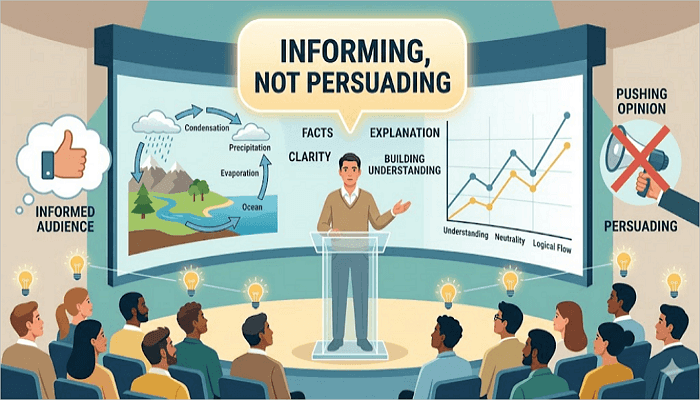
Imagine a student explaining how photosynthesis converts sunlight into energy using a labeled diagram, or a marketing analyst presenting quarterly sales data to the leadership team. Both of these are informative speeches.
They are regarded as “informative” because they focus on facts, clarity, and explanation, without any attempt from the speaker to persuade the audience. When delivering an informative speech, your job is to build understanding, not to push an opinion.
The language stays neutral, the structure is logical, and every point should be about making the audience more knowledgeable than they were before.
Here are some informative speech topic ideas you can speak on:
- The science behind renewable energy
- How physical activity improves concentration
- The role of mental health awareness
- Why music gets stuck in your head
- The history of written language
2. Persuasive Speech
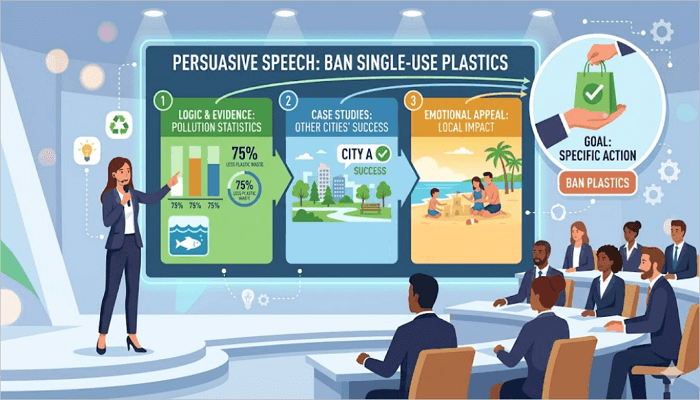
Now picture an environmental activist urging a city council to ban single-use plastics. Usually, they’ll share statistics on how it pollutes the oceans, reference case studies from cities that already made the switch, and close with a call-to-action or a personal story about a local beach cleanup. This is a persuasive speech in action.
What makes it persuasive is more than strong language. It is the intention to change what the audience already believes or to move them toward a specific action, which in this case is to ban single-use plastics.
The speaker builds a case using a mix of logic, evidence, and emotional appeal. In a persuasive speech, you choose every point deliberately to help the audience overcome doubt and create conviction.
Let’s explore some other examples of persuasive speech topics:
- Are private schools better than public schools?
- The government should impose subsidies on electric vehicles
- School uniforms do not improve discipline
- Is burnout becoming a lifestyle disease?
- Should AI replace human customer service?
3. Entertaining Speech
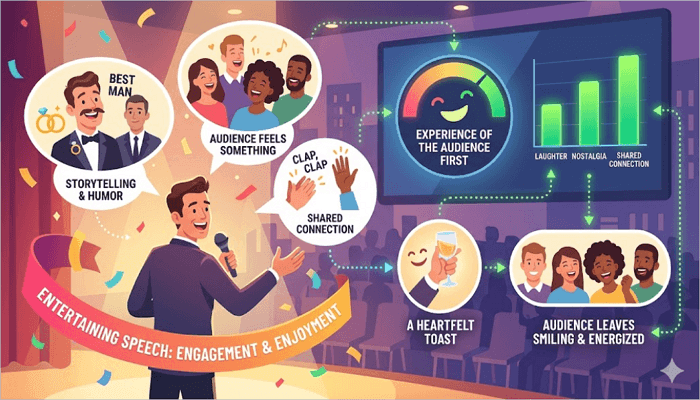
You’ve most likely been to a wedding ceremony and seen someone, probably the best man, sharing funny stories about the groom, making everyone laugh, and ending with a heartfelt toast. That is a classic example of an entertaining speech.
The main purpose of this speech is engagement and enjoyment. The audience is not there to learn a new skill or change their thinking—they are there to feel something, which could be laughter, nostalgia, or a sense of shared connection.
Entertaining speeches are delivered through storytelling, timing, humor, and emotional warmth. And while it can still carry a message or information, the experience of the audience always comes first. If they leave smiling and energized, it means that your speech has been entertaining enough.
4. Demonstrative Speech
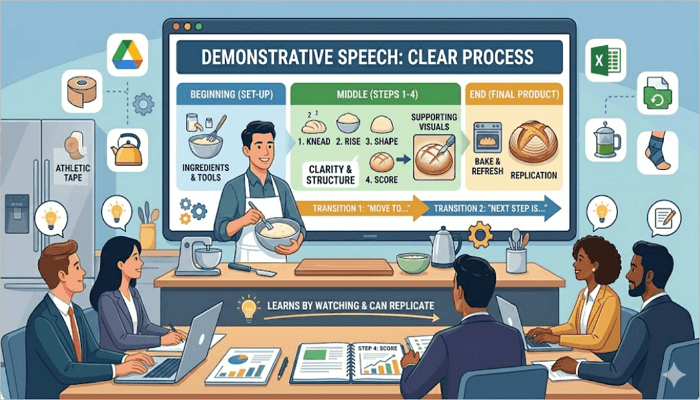
Sometimes, you can deliver a speech showing how something works. Take, for example, a cooking instructor walking a class through the steps of making sourdough bread. In a scenario like this, the audience follows a live process and learns by watching how it happens.
The speaker breaks a process into clear stages, often supporting it with visuals, physical materials, or live tools. All the audience has to do is follow along and replicate the steps afterward.
Clarity and structure are the most important elements of demonstrative speeches. Without a clear beginning, middle, and end to the process, you lose your audience quickly. Also, transitions between steps like “now that we’ve done this, let’s move to…” help maintain flow and keep the audience on track.
Check out these demonstrative speech ideas for your next speech:
- How to back up files to Google Drive
- Create a simple budget spreadsheet in Excel
- How to tape a sprained ankle with athletic tape
- How to brew the perfect tea
5. Special Occasion (Ceremonial) Speech
Some speeches are meant for important moments. They are also defined more by context than by structure.
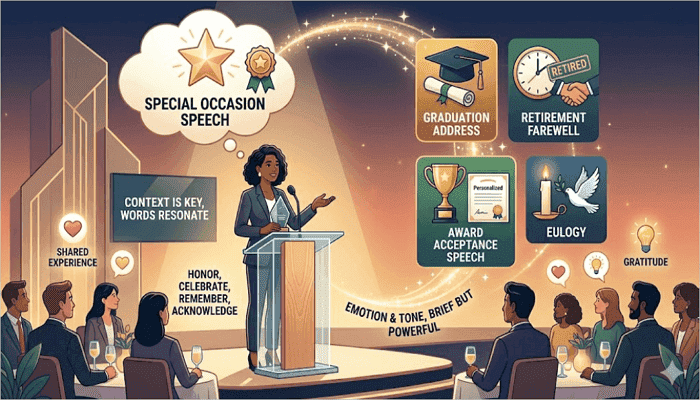
Emotion and tone are what make special occasion speeches unique. The purpose of these speeches is to honor, celebrate, remember, or acknowledge, so the words must resonate with what the audience is already feeling. They reference shared experiences, express gratitude, and leave the audience with a sense of connection to the moment.
For example, an award acceptance speech by the awardee that ties accomplishments to something personal and meaningful will stay with the audience long after the event has ended. Other examples of these speeches may be a graduation address, a retirement farewell, or an eulogy.
6. Other Types of Speech (Based on Context)
While we can classify different kinds of speech, not every speech fits neatly into these main categories. Some speeches emerge from specific contexts and often overlap with multiple categories at once. This is why understanding the purpose of your speech remains the most important skill when creating.
Here are other types of speeches based on context:
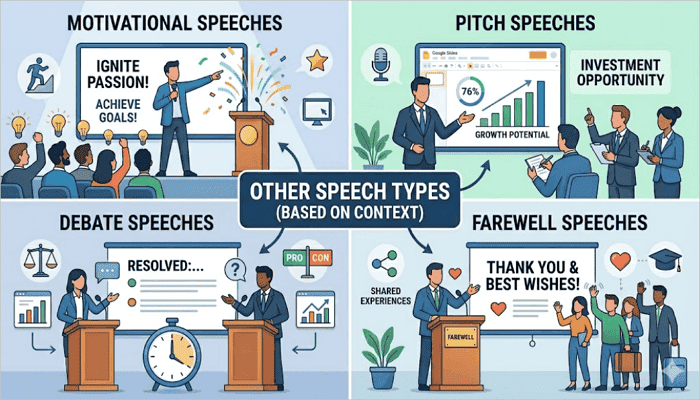
- Motivational speeches: Inspire action through emotions rather than argument. A good example is a coach’s halftime talk with his team.
- Pitch speeches: Combines persuasion and information. They are common in business settings, such as a startup founder presenting to investors.
- Debate speeches: These are structured arguments, usually with a set format and opposing sides. The goal is to win the argument by the end of the session.
- Farewell speeches: Similar to ceremonial speeches, but focus on departure and gratitude. An example is a retirement speech at a retirement event.
How to Choose the Right Type of Speech?
Now that you understand what the different types of speech are, how do you know which one to use?
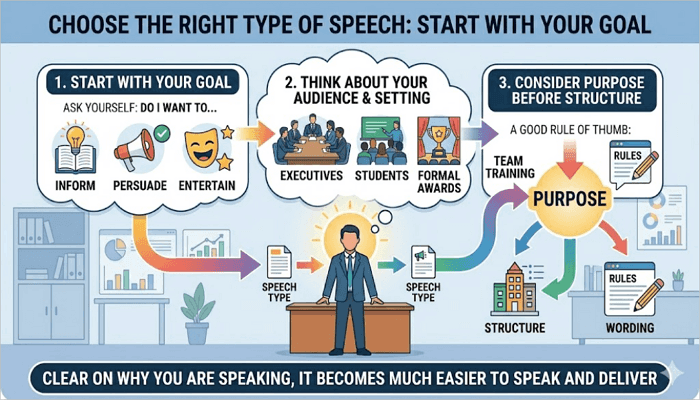
In a situation like this, the first thing to do is start with your goal. Ask yourself: Do I want to inform, persuade, or entertain?
After identifying your main goal, think about your audience and setting. A room of executives expects a different register than a classroom of students. A formal awards ceremony calls for a different tone than a team training session.
A good rule of thumb is to always consider the purpose of your speech before structure or wording. Once you are clear on why you are speaking, it becomes much easier to speak and deliver your speech.
Conclusion
The most important decision you can make when preparing a speech is choosing the right type. Get it right, and your speech will fulfill its purpose.
Most weak speeches fail, not because the speaker ran out of things to say, but because they chose the wrong type for the situation. They probably tried to entertain when the room needed information, or they only informed when the audience needed to be persuaded to take action.
Just knowing the different types of speech isn’t enough. When preparing your next speech, start by identifying your goal and matching it to the right type before writing anything.
More About Different Kinds of Speech
You should also learn how to apply your knowledge of different speech types to real situations at school, work, or events.
1. What are the kinds of speech in English?
In English, the main kinds of speech include:
- Informative speeches
- Persuasive speeches
- Entertaining speeches
- Demonstrative speeches
- Ceremonial speeches
They are grouped by purpose. For example, a demonstrative speech shows the audience how a process works step-by-step.
These speeches can be used in different scenarios, from classroom presentations and business pitches to wedding toasts and graduation addresses.
2. What is an example of entertainment speech?
Entertainment speeches can be used in several scenarios. An example is a best man’s toast at a wedding. It combines personal stories, humor, and warmth to engage the audience emotionally.
Another example of an entertainment speech is an after-dinner speech at a corporate gala, where the goal is to close the evening on an enjoyable note.
3. What is an example of a public speaking speech?
An example of a public speaking speech is a TED Talk on climate change, where the speaker uses facts, storytelling, and visuals to inform and, at the same time, inspire the audience.
It could also be a student presenting a research project in class—organized, delivered to an audience, and built around a clear purpose.